Inside the project
Prepared with the project’s development agent from source and retained evidence. This is a project-owner assessment, not an independent customer review. Dated checks were not rerun for this website.
Acoustician is useful when a musician or audio developer wants to inspect a recording, audition estimated layers and investigate a drum part using several complementary methods. Its strongest demonstrated workflow combines native stereo handling, session-specific reference fitting, explicit remainders and reproducible comparisons. The installed event-reference method models attack and decay jointly and allows simultaneous pieces; optional LarsNet processing supplies five broad drum groups. The studio also exposes a spectrogram, markers, source controls and a modular analysis rack. Practical usefulness depends on the material and the selected method. A controlled 909 comparison improved with event fitting, while Brazilian percussion tests were mixed, and a later absence-aware candidate failed quiet-hit and tail checks. That makes Acoustician a substantial local studio and research application whose results should be auditioned and inspected. It is not a verified perfect kit-piece separator or an established public commercial release.
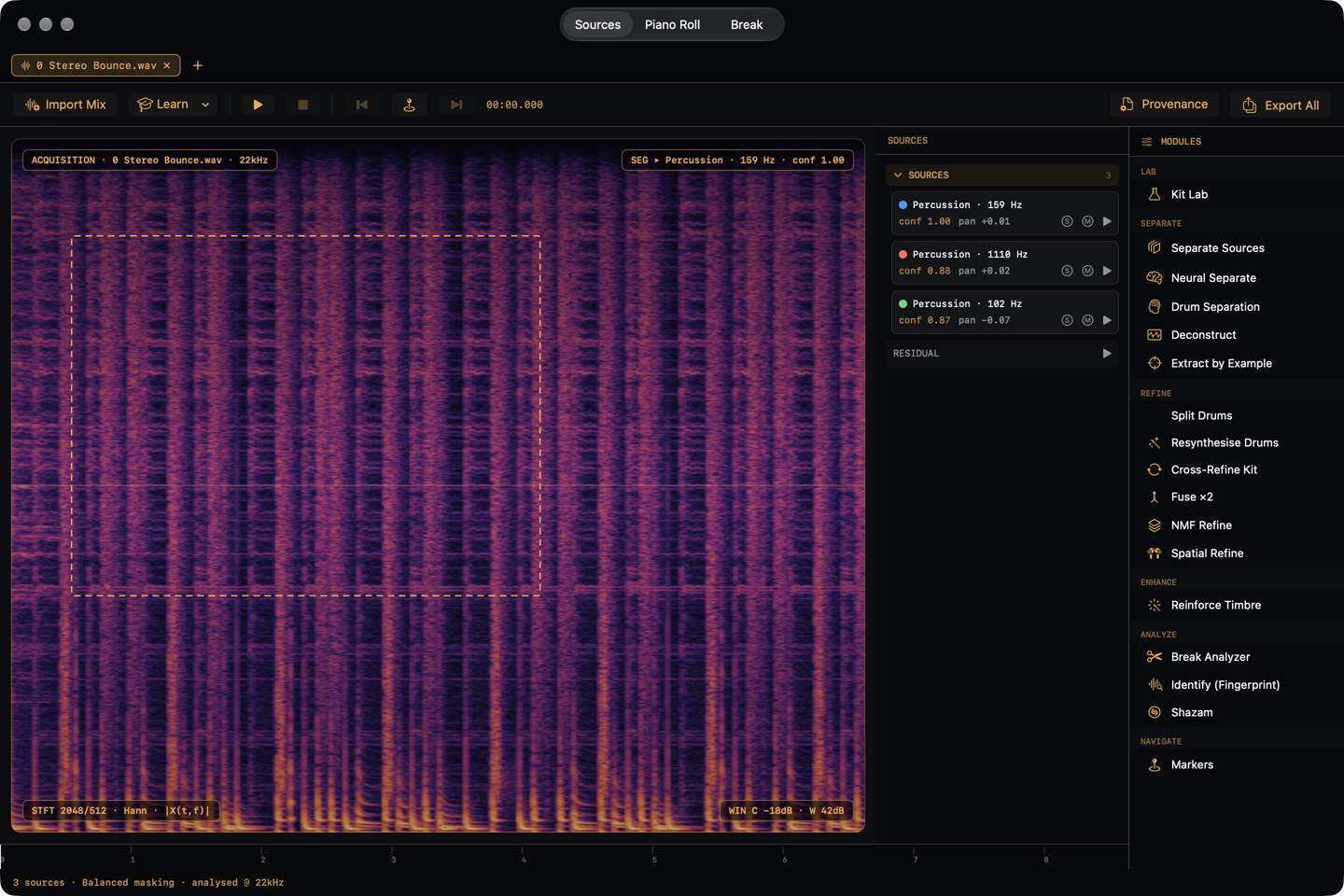
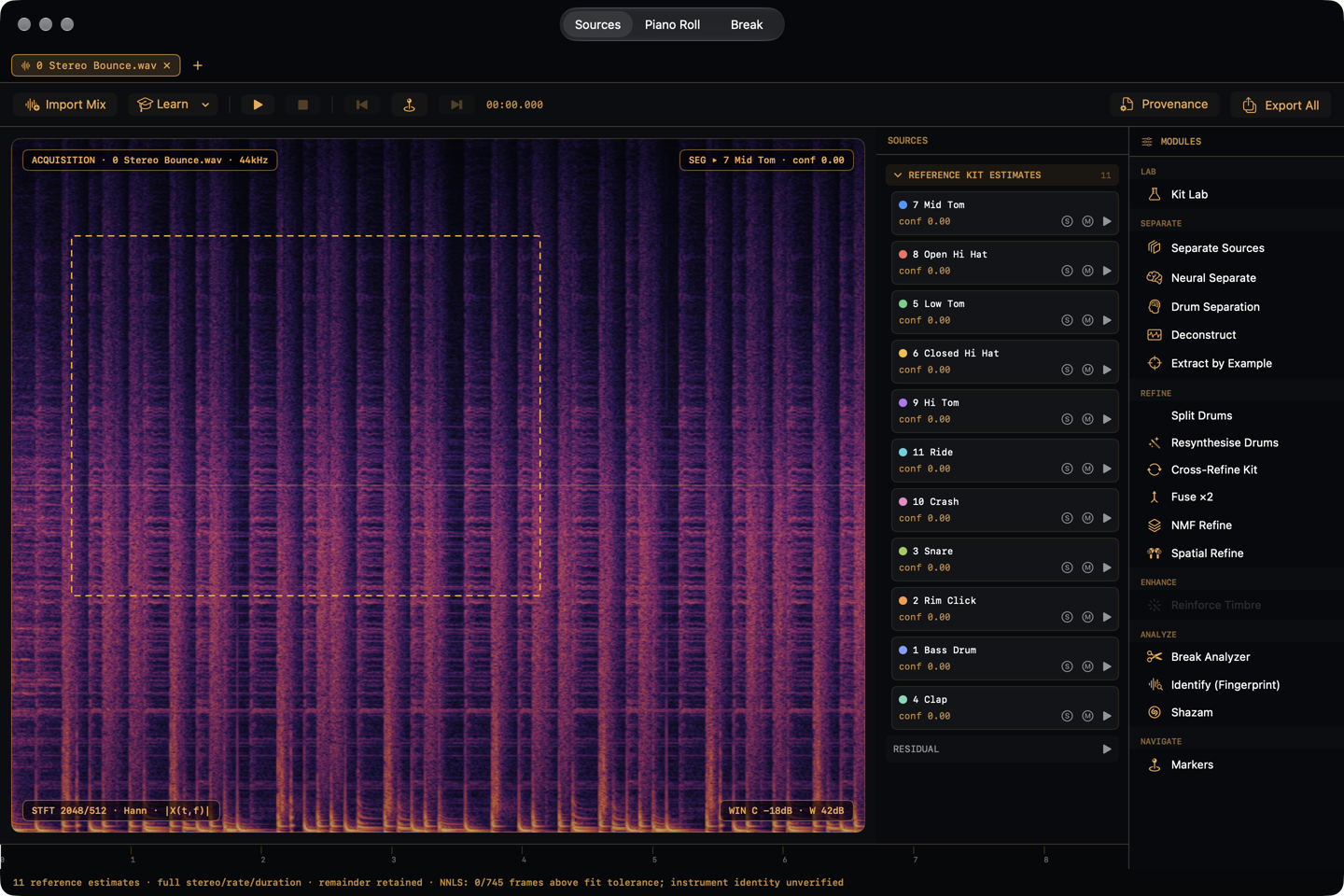
The 18 October website capture shows a supplied 909 bounce and eleven same-session kit references using Spectral NNLS, with synthetic restoration at zero. The 34.65-second comparison uses genuine native captures and actual exported audio; the result-window footage is looped and the soundtrack is edited, rather than recorded from live audition buttons. Original audio, selected estimates, their sum and the retained remainder can be compared. This bounded demonstration does not establish unseen-kit generalisation or complete isolation.
What stands out
- Reference fitting uses isolated stems from the recording to adapt to its kit, with spectral and experimental temporal methods available for comparison.
- The reference and LarsNet paths preserve the full original stereo rate and duration, retain a remainder and distinguish estimates from the authoritative source.
- Retained manifests, per-piece metrics and common-gain listening previews make successful and unsuccessful results reviewable.
- Native inspection and specialist analysis share an engine with AssistantApp, avoiding a second standalone implementation.
Current limits
- LarsNet supplies kick, snare, toms, hi-hat and cymbals groups; it does not independently recover every tom, open/closed hat, ride, crash, rim or clap.
- Quiet notes, overlapping tails and acoustic or Brazilian instrument confusion remain unresolved. Reconstruction conservation, solver convergence and display confidence are not instrument-accuracy measurements.
- The custom query-model contract has execution/parity evidence but no documented production-quality trained model. Generalisation to independent kits, players and rooms remains unproven.
- The linked standalone build requires macOS 26. Optional models require local provisioning. Public download availability, a clean native screenshot/video and publication clearance for supplied audio remain unverified.
Features & evidence
Studio inspection and audition
sourceImport a recording, inspect the spectrogram, mark passages and select or audition estimated sources.
Recorded evidence
18 Oct 2026: current StudioView and module catalog inspected. The 11 Oct standalone build had a short GUI smoke launch; this is not per-control interactive acceptance.
Reference Kit: spectral and event fitting
installed-testedChoose isolated kit stems, compare methods and split the original stereo with a retained remainder.
Recorded evidence
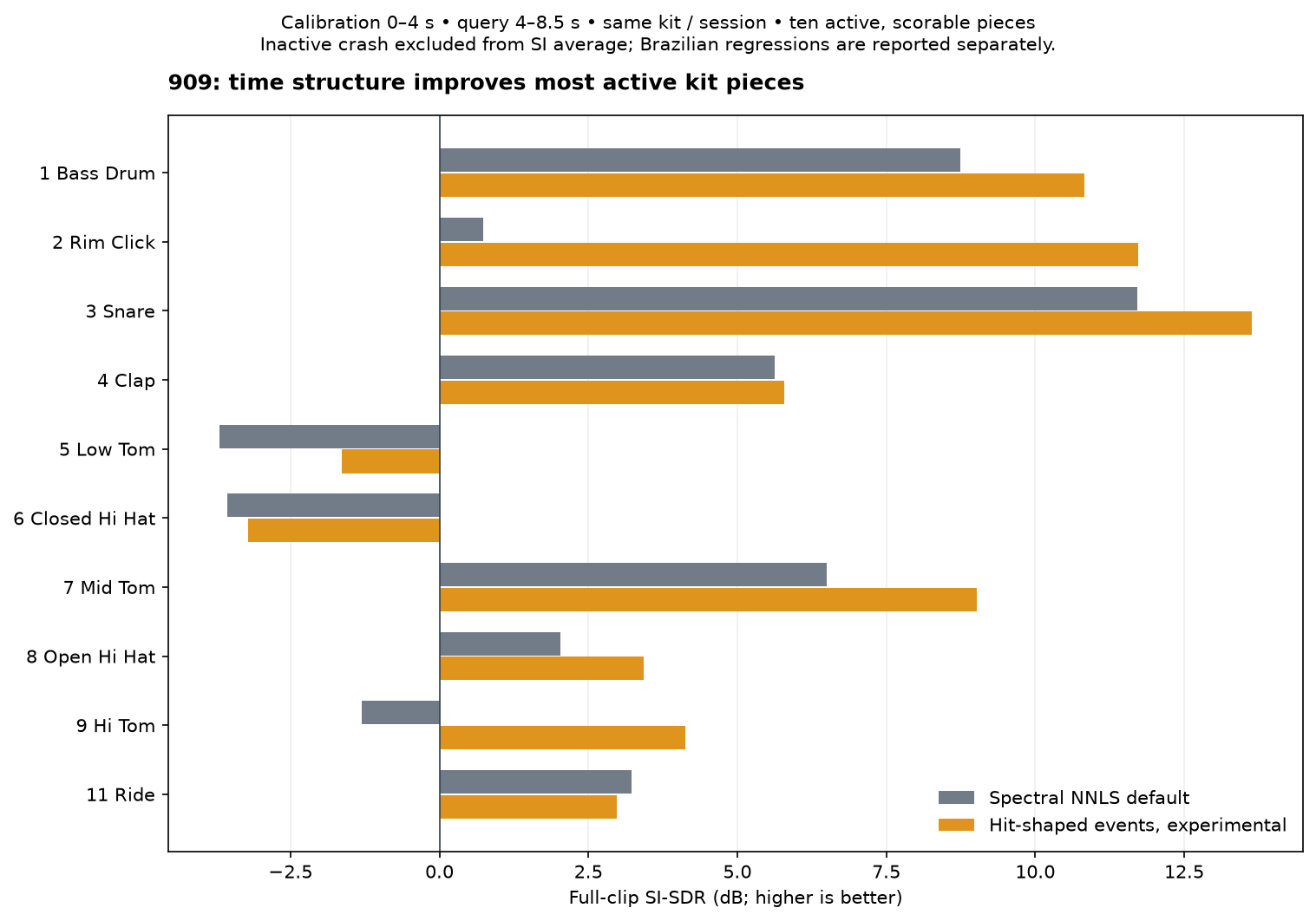
11 Oct: linked build/install and self-checks passed; 114 output WAVs matched the frozen prototype sample-for-sample. Current shared selector confirmed 18 Oct. Same-session 909 mean SI-SDR: 3.002 to 5.666 dB; Brazilian regressions remain explicit.
LarsNet drum groups
installed-testedProcess a complete stereo drum bus into five neural groups and a remainder, with model/inference receipts.
Recorded evidence
11 Oct: actual CPU/MPS inference and a complete 379.692698-second 92 BPM stereo render recorded. Third-party checkpoints, documented CC BY-NC 4.0; no blanket individual-piece accuracy claim.
Kit Lab and specialist modules
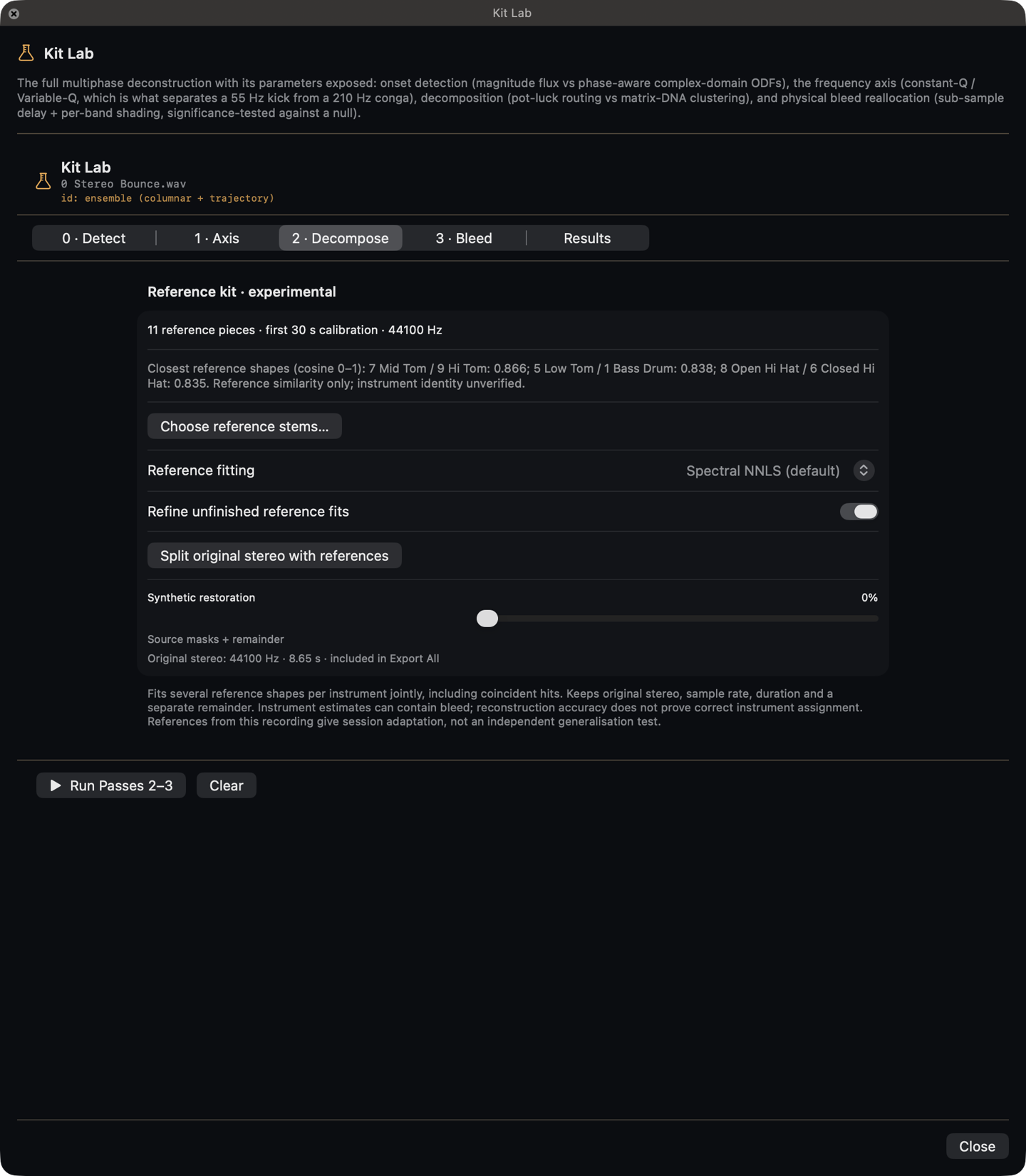
sourceInspect detection, frequency-axis, decomposition and bleed stages; explore extraction, break analysis and refinement controls.
Recorded evidence
18 Oct: shared Kit Lab source and retained catalog remain present. Source availability is not independent runtime validation of every module.
Exports and provenance
sourceExport estimated WAVs, remainder, decoded original stereo and separation metadata; distinguish synthetic restoration.
Recorded evidence
Retained engine export implementation records rate, frames, groups and initial reference-fit information. Source files remain authoritative; synthesized restoration is a separate derivative.
Candidate acceptance and listening review
component-testedCheck omitted-piece output alongside quiet-piece gain, waveform fit and tails; compare aligned audio at common gain.
Recorded evidence
11 Oct retained results: 26 Python benchmark tests and 18 private Swift checks passed. The soft candidate nevertheless failed acceptance with 15 findings and was not installed. No tests rerun today.
Finer articulation and absence modelling
plannedSeparate attack/body/decay evidence and learn multiple articulations with conservative uncertainty handling.
Recorded evidence
Priorities in the 11 Oct event/soft-presence reports; not an installed new mode or a quality-trained model.
Review updates & corrections
- No material application change established since the 17 Oct biography. On 18 Oct, installed version 1.0/build 1 still hashes to the verified 11 Oct executable; it was not launched or retested.
- The nine-entry event-build source snapshot again differs only at the benchmark README. This is a bounded source check, not parity of the entire repository.
- Clarification for website curation: existing charts are research figures, the icon is branding, and the interactive comparison is a local research artifact. None substitutes for a clean native product screenshot or released web demo.
- 18 October 2026: real media handoff integrated into this page; captions distinguish native captures, edited comparisons and working web demonstrations.
Workflow walkthrough
A guide to the native workflow. These steps describe the app; only the recordings and images embedded on this page are available as website demonstrations.
- Existing local research demo, not a native capture: open the retained quiet-ride review HTML with its relative media directory. It covers a 4.5-second controlled 909 query with the ride reduced by 12 dB.
- Select the mixture and the author-provided ride target to hear the challenge. These are evaluation examples; the target is not supplied to separator inference.
- Switch between installed-event, low-global and soft estimates while preserving passage position. The saved preview binding specifies one common gain of 1.0, native stereo/rate/duration and PCM24 listening derivatives.
- Compare the omitted-piece and quiet-piece charts together: reduced phantom output must not conceal weaker quiet notes or damaged tails.
- End on the retained acceptance result: this candidate was rejected. For public presentation, first clear the audio, remove internal paths from metadata and package the assets; the local HTML is not already deployed on the website.
Development biography · earlier archive
Development profile compiled from project source and retained records in October 2026. Dates and test results describe those records; they do not imply a new build, live acceptance test or public release.
Detailed project biography
Acoustician brings together two activities that are often separated in music software: working creatively with a recording and examining whether a processing result is actually trustworthy. A producer may want to isolate a kick, identify a break, explore a harmonic layer or recover the character of an instrument. A researcher may want to compare algorithms, measure spill, or understand why a quiet cymbal disappears. Acoustician gives these activities a shared workspace while keeping an estimate distinct from the original recording.
The standalone application grew from the Acoustician module inside AssistantApp. Its studio compiles the shared Acoustician and StemSplitter source rather than maintaining a second separation engine. The interface gives that engine a dedicated home: a real short-time Fourier-transform spectrogram, an amber-on-dark acquisition display, a timeline with markers, a source panel and a categorized module rack. Floating parameter panels expose different operations without requiring the user to treat every audio problem as the same kind of separation.
The central problem is that a drum recording is more complicated than a list of instruments. Kick and snare can arrive together. A cymbal continues ringing while another piece is struck. Ghost notes may sit below louder attacks, and a microphone assigned to one drum also hears its neighbours. Electronic drums introduce another opportunity: some hits repeat closely enough to support reference matching, but sampled or noise-based sounds still vary. The project's documented direction is to distinguish these situations and assess individual pieces rather than equating a broad “drums” stem with a recovered kit.
A typical session starts by importing audio and examining its spectrogram. The user auditions the recording, moves through the timeline, marks passages and chooses an operation suited to the material. The source panel makes the resulting layers available for selection, soloing, muting and playback. Generic DSP quality modes trade processing breadth against isolation and resource limits. Neural actions use an available local backend, while an unavailable model produces a visible status instead of silently claiming that another method performed the work.
For a complete drum bus, the optional LarsNet integration offers five broad stereo groups: kick, snare, toms, hi-hat and cymbals. Acoustician's adapter processes the complete original stereo acquisition and returns estimates at its original rate and duration, with a separate remainder and an inference receipt. This is an integration of the published third-party model, not an Entertrainment-authored neural architecture. It also does not imply separate recovery of every tom, open and closed hat, ride, crash, rim or clap.
When suitable isolated instrument stems are available from the same recording, reference-kit fitting offers another route. The default spectral method learns several shapes per instrument and fits them jointly. An optional event method also models approximately 300 milliseconds of attack and decay, allowing several instruments to activate together. This gives the user a concrete comparison between spectral similarity and time-varying hit structure. The result preserves original complex stereo through masks and retains unassigned material in the remainder; neither convergence nor reconstruction conservation proves that the labels are correct.
Kit Lab exposes the investigation itself. Its stages cover onset detection, frequency representation, decomposition and bleed analysis, followed by measured results. The user can compare magnitude-flux and phase-aware onset approaches, explore constant-Q or variable-Q frequency axes, and inspect the effects of different decomposition choices. Elsewhere in the rack, tonal/transient/noise decomposition, query-by-example extraction, drum resynthesis, cross-refinement, fingerprint identification and break analysis provide further ways to examine or transform material. Their presence in source is distinguished from a claim that every operation has completed independent runtime acceptance.
Acoustician also makes a deliberate distinction between separation and restoration. Source-mask drum processing is accompanied by a remainder; adding modelled timbre is an explicit synthetic-restoration choice. Exports identify the stems and processing metadata, and can include the original decoded stereo alongside the estimates. The source file remains authoritative. The shared segmentation model records the acquisition, analysis priors and derived overlays using audio-native provenance, including JSON-LD representation.
The research workflow is an important part of the project's identity. On 11 October 2026, the event-reference method improved the mean stereo SI-SDR on a controlled 909 excerpt from 3.002 to 5.666 dB, while Brazilian percussion comparisons remained mixed and sometimes poor. A later conditional-residual experiment reduced false hat and ride output, but damaged some quiet notes and tails; it failed acceptance and was not installed. Hash-checked manifests, per-piece scores, omission challenges and same-position listening comparisons make those limitations reviewable. These are recording-specific adaptation results, not proof of universal accuracy.
For musicians and audio developers, the distinctive proposition is therefore a studio where listening, experimentation and evidence can inform one another. The roadmap aims at stronger attack/body/decay representations, multiple articulations, conservative absence handling and validation on distinct kits, players and rooms. Acoustician is already a substantial local application and research tool; perfect individual-piece recovery from arbitrary acoustic or electronic mixes remains an open objective.
Features and what a visitor can see or hear
| Feature | Visitor-facing experience | Ownership and qualification |
|---|---|---|
| Acquisition studio | Spectrogram, selection region, timeline markers and auditioning | Authored SwiftUI/AppKit studio over shared DSP; no clean product screenshot located in this intake |
| Source management and export | Solo/mute/play estimated layers, inspect remainder, export WAV and metadata | Authored engine/UI; reference and LarsNet paths preserve complete original stereo/rate/duration |
| Generic DSP separation/refinement | Compare masking modes, DSP, NMF and spatial refinement | Authored module and StemSplitter operators; quality tiers can use bounded analysis representations |
| Neural Separate | Run an installed neural backend; standalone catalog names HTDemucs | Third-party model integration; availability/model-specific behaviour must be shown accurately |
| LarsNet Drum Separation | Five broad stereo drum groups plus remainder | Published third-party checkpoints; not every individual kit piece |
| Reference Kit | Learn from supplied isolated stems; compare spectral NNLS with hit-shaped event fitting | Authored session-adaptation engine; event method explicitly experimental |
| Kit Lab | Compare detection, axis, decomposition and bleed stages; inspect reports and abstentions | Authored shared panel, with package-backed computation where available |
| Musical analysis/transformation | Break analysis, example-based extraction, tonal/transient/noise layers, restoration controls | Source-implemented modules; synthetic restoration is a labelled derivative |
| Evaluation and listening review | Hear aligned comparisons; inspect quiet-hit, tail and omitted-piece results | Authored benchmark tools, source hashes, frozen metrics and common-gain previews |
Technical foundations
Swift/SwiftUI/AppKit provide the native studio, AVFoundation handles audio, and Accelerate supports spectral and fitting computation. The linked standalone package uses Swift tools 6.2 in Swift 5 language mode and a macOS 26 deployment floor. The shared STFT uses a 2048-point Hann window and 512-sample hop for the reference/reconstruction paths.
Local packages are SemanticCompute, Kalman (including the listed harmonics/DKF/prosody products) and FIRFilters. October evidence records SC 1.28.0 with 261 families; that is a dated verification, not a fresh 17 October server-capability claim. Neural helpers use local Python/PyTorch environments. The experimental custom Core ML query path has a corrected versioned stereo/raw-complex contract, but no quality-trained custom model is supplied by the documented training workflow.
The immutable-acquisition/provenance model distinguishes original audio, estimates, remainder and explicitly synthetic derivatives. Separation metadata and model receipts record the operation/settings rather than treating a UI confidence value as measured correctness.
Maturity and dated evidence
| Area | Verified state | Limit |
|---|---|---|
| Standalone package and installed app | 11 Oct: linked release build/install, full self-checks with zero failures, strict code-sign check and short GUI smoke launch recorded | Not a fresh full runtime acceptance on 17 Oct |
| Current installed identity | 17 Oct read-only: bundle 1.0, build 1; executable SHA256 still 1c2fc18bbea7494fb50c5244060094a88b8df7dbd46c29e89ea8350d2c557298, matching the 11 Oct verified build | Static identity check, not re-execution |
| Shared reference event fitter | Source present in both hosts; 11 Oct standalone installed; 114 compared WAVs matched frozen prototype samples | Full AssistantApp host was not rebuilt in that evidence batch |
| Stereo LarsNet adapter | 11 Oct real CPU/MPS inference and full 379.692698-second 92 BPM stereo export recorded | Five broad groups; microphone stems are not clean instrument truth |
| Custom query-model training contract | Python/Swift feature-contract and analytic smoke training evidence recorded | Execution/parity only; no production-quality trained separator |
| Absence-aware candidate | Private 11 Oct experiment; 26 Python benchmark tests and 18 private Swift checks passed | Candidate rejected with 15 findings; not an installed feature |
| Public distribution | No verified Acoustician public download, release page or App Store listing identified from inspected materials | Present as a local research application, not a public commercial release |
| Current source drift | 17 Oct: nine entries in the event-phase source snapshot checked; only benchmark README differs | This does not establish parity of every unrelated repository file |
Roadmap and limitations
- Separate attack, body and decay evidence; learn multiple articulations and dynamic levels.
- Develop presence/absence/uncertain states using omitted-piece negatives and quiet positives, without cutting tails or ghost notes.
- Qualify machine-specific waveform matching for offsets, gain, polarity, collisions and hat chokes.
- Improve fine kit taxonomy beyond LarsNet's five groups, including individual toms and cymbals.
- Expand evaluation to independent kits, sessions, players and rooms; acoustic, electronic and Brazilian sources need distinct evidence.
- Evaluate phase-capable reconstruction and listening quality once instrument identity improves.
Existing limits include overlap, bleed, weak/noisy pieces, dependent reference examples, analysis/model resource bounds and optional external-model installation. A stem sum matching the input is a conservation check, not proof of correct instrument assignment. The event fitter stays optional because several Brazilian comparisons regress.
FAQs
Does Acoustician recover every drum perfectly? No. Broad neural groups, discovered timbre clusters and reference-conditioned pieces are different outputs. Quiet hits, overlap and tails remain active research problems.
Can I supply my own kit stems? Yes, the reference workflow accepts isolated instrument stems from the same kit/session. Overheads, room channels, full mixes and duplicate bounces should not be treated as isolated instruments.
Is the result generated audio or separated source audio? Reference fitting uses source masks plus a remainder. Synthetic restoration is a separate explicit choice and creates a derivative. The original source remains authoritative.
Does it work locally? Most analysis and installed-model processing is local. Models/dependencies need provisioning, and optional ShazamKit recognition needs network access and entitlements.
Can I download a released version? A local installed macOS app is verified. No public Acoustician download was verified for this intake. The linked build requires macOS 26; source-level iOS/AUv3 work is not a confirmed released product.