Inside the project
Prepared with the project’s development agent from source and retained evidence. This is a project-owner assessment, not an independent customer review. Dated checks were not rerun for this website.
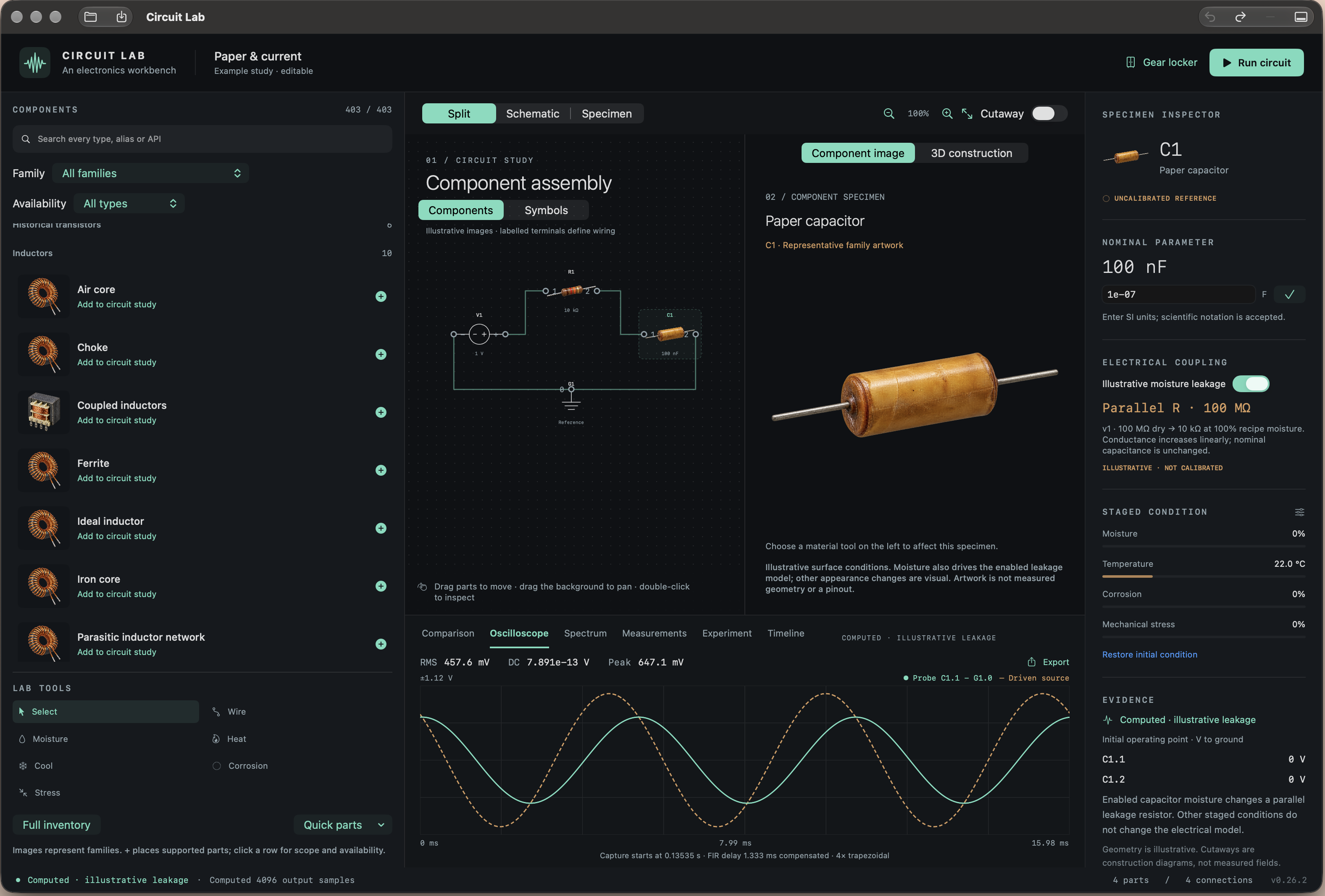
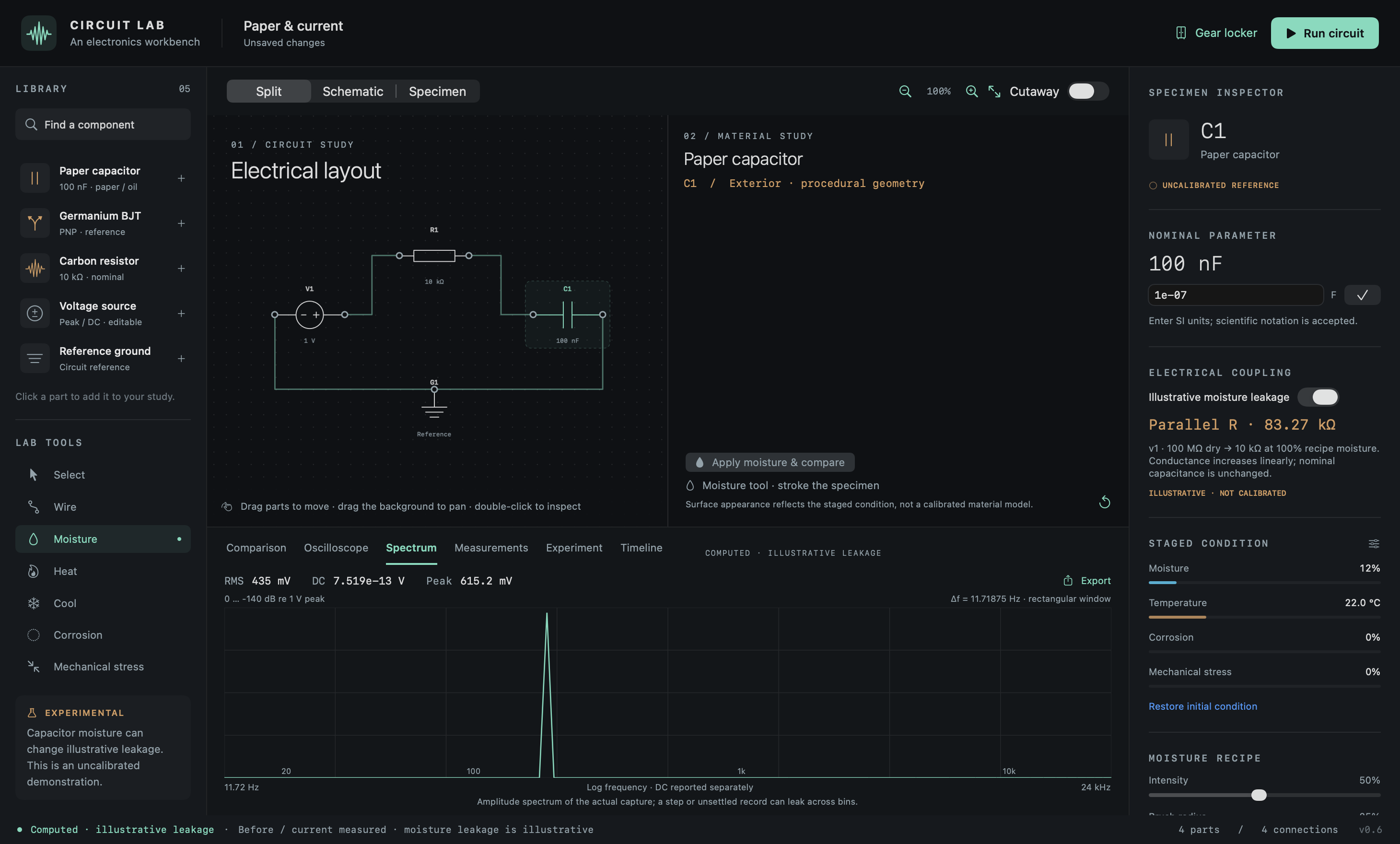
Circuit Lab is a Swift laboratory for electronics and audio in which every knob, wire and intervention enters real circuit equations. Its strongest working piece is the macOS Workbench: a schematic you can wire, a Metal specimen you can orbit and stroke with moisture, shared oscilloscope and spectrum instruments, and a photographed Fuzz Factory whose five rotaries drive a nonlinear circuit solve that you can hear through file playback or a live audio interface. Behind it sit ten engine packages with milestone-by-milestone evidence folders and pinned ngspice comparisons, an MX-120 research model, a Circuit Bending explorer that attributes sound changes to individual bends with Shapley shares, and seven Stellar oscillator packages validated on real Core Audio hardware. The honest limits are stated on every screen: nothing is hardware-calibrated, the fuzz model is an E1 reconstruction with synthetic transistors, the inspected Workbench paths are buffered previews rather than certified real-time engines, and the UI is three sessions' work awaiting a normalisation that was only planned on 17 October. It is useful today as a transparent research bench and a reference for how to bound modelling claims; this Workbench copy is not a public product release; the separate Adult electronics review covers the MXR AUv3 preview.
What stands out
- Circuit-first audio: resistors, capacitors and transistors are MNA stamps, never DSP stand-ins; wiring and loading decide the result.
- Evidence discipline: each milestone ships a folder with test logs, build hashes and sha256 manifests; ngspice oracles for selected fixtures.
- Fuzz Factory Workbench surface is installed-tested to v0.21.0 with 137 release tests, 45 guitar playback cases and zero underruns in recorded workloads (15 Oct 2026).
- Circuit Bending gives causal attribution across three bends with 24 static DC checks before any transient, plus a device-tested live monitor (17 Oct 2026).
- Stellar prepared-network renderer completed a 60 s hardware soak at 44.1 kHz / 512 frames with no budget miss (13 Oct 2026).
Current limits
- No hardware calibration anywhere; fuzz and MX-120 are uncalibrated reconstructions and say so on screen.
- Fuzz v0.21 misses its 3% cross-timestep accuracy target (worst 7.39%); MX-120 real-time playback misses 960/960 deadlines.
- Three UI streams (gear locker takeover, study workspace, separate bending windows) are not yet one window; the normalisation plan has no delivered steps.
- No audio, video or Bending/Stellar screenshots exist in the repository; only Workbench and MXR PNG captures.
- Workbench README header is stale (says v0.16.0; evidence runs to v0.21.0).
Features & evidence
Schematic, specimen and instruments (RC study)
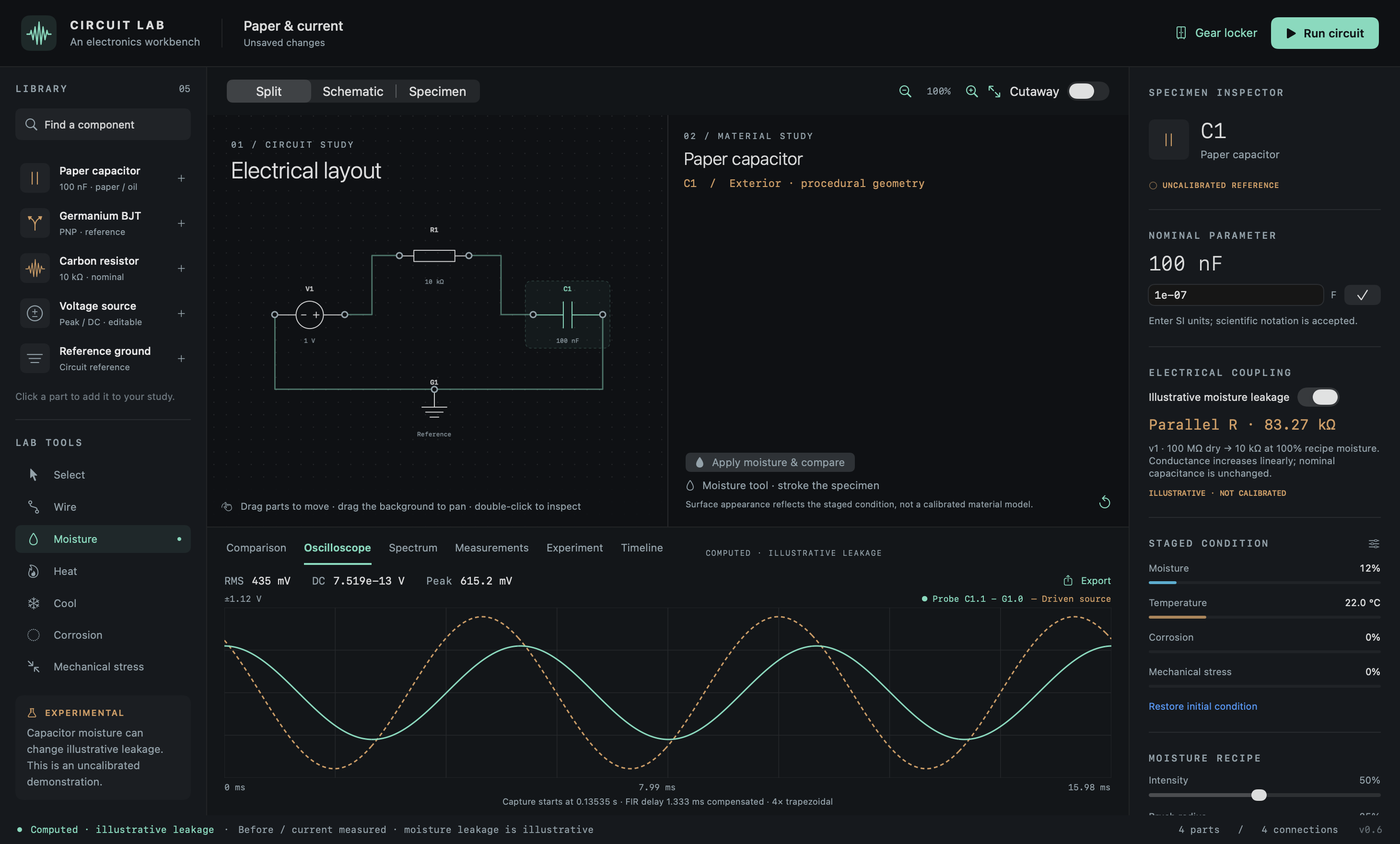
installed-testedWire parts, orbit a Metal specimen, apply moisture/heat/corrosion recipes, run sine/DC/step, read scope/spectrum/measurements, branching undo, versioned JSON studies.
Recorded evidence
Workbench suites v0.3–v0.10 (78–88 tests); Documentation/Workbench/Validation.md; previews captured v0.6 (13 Oct 2026 era).
Photographic Fuzz Factory controller
installed-testedDrag five knobs on the enclosure photo (Shift fine, double-click reset, one undo per drag); E1 circuit candidate re-solves.
Recorded evidence
Rotaries-v0.5.md dated 2026-10-13; FuzzRotaryTests in Apps/CircuitLabWorkbench/Tests/WorkbenchUITests; v0.21.0 app hashes in Evidence-v0.21/build.json (143 files verified).
Guitar audition and live input
installed-testedLoad audio or the owner's guitar excerpt, play dry/processed; or select an interface and monitor live through the circuit with 23.2 ms lookahead.
Recorded evidence
v0.7 acceptance 13 Oct 2026 (176,400 frames, zero clipped); Live-Input-v0.16.md 2026-10-15; Live-Germanium-Accuracy-v0.21.md 15 Oct 2026. External interface not physically accepted.
Circuit & components editor and open-box view
installed-testedEdit the solver's actual netlist (R/C values, transistor models, reconnect nodes); illustrative 3D layout.
Recorded evidence
v0.8 suite 78 tests; Open-Box-v0.8.md; label ILLUSTRATIVE LAYOUT.
MX-120 phase one research demo
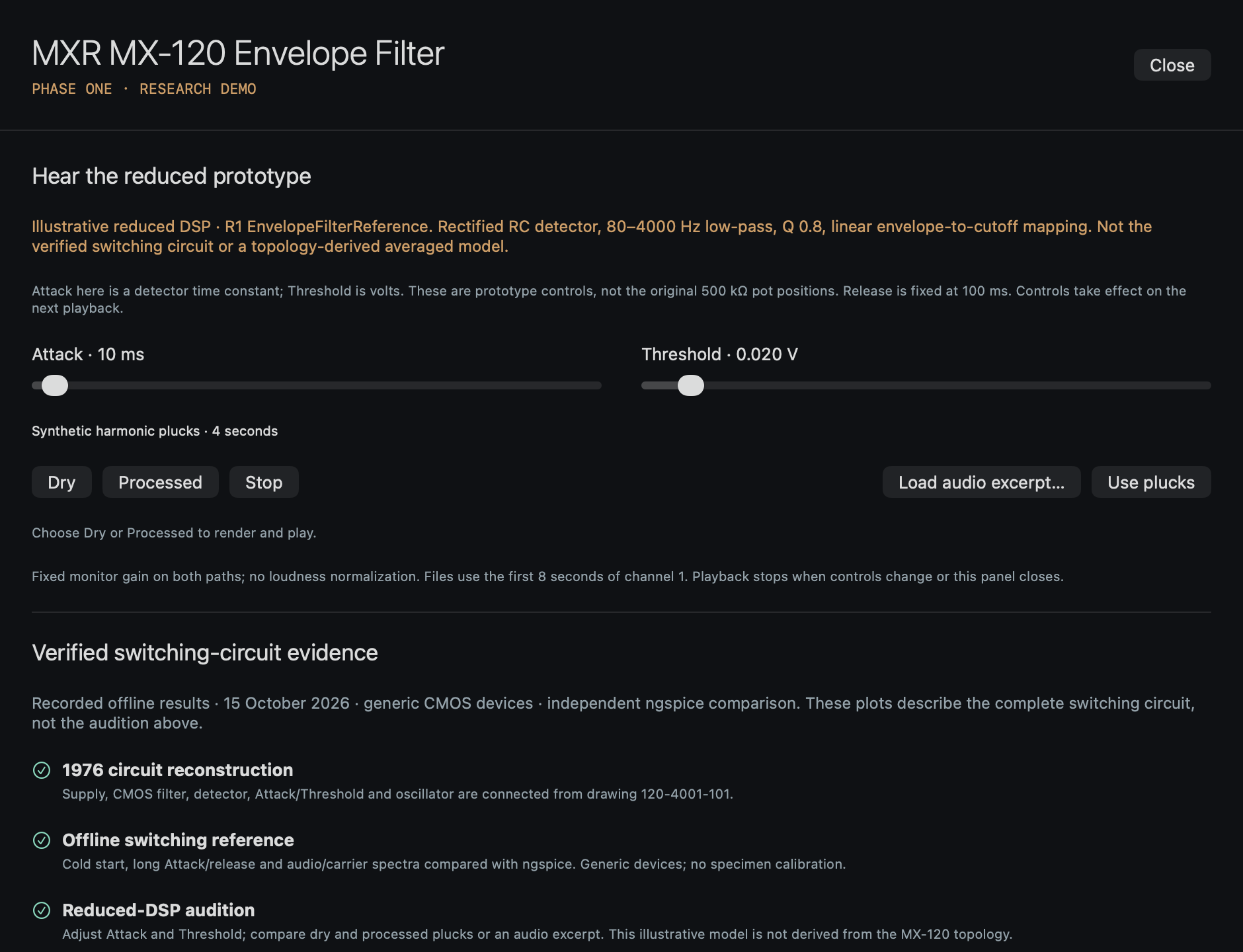
installed-testedAudition averaged-circuit and reduced-DSP models with Attack/Threshold, inspect bundled ngspice plots.
Recorded evidence
Documentation/MXREnvelopeFilter/PhaseOneDemo.md; FullRange validation 10/10 cases, 25 control combinations; recorded 15 Oct 2026; real-time 5.24 CPU s per audio s.
Engine packages (ten)
component-testedNetlists, MNA, nonlinear devices, oversampled rendering, logic, converters, DSP, physical models, measurements, catalogue.
Recorded evidence
Milestones 0.2–0.36 in Documentation/Roadmap.md and ImplementationStatus.md (inspected 2026-10-15); ngspice fixtures under Documentation/SPICE.
Circuit Bending explorer
installed-testedChoose RC or diode fixture, set three bridges, preview 24 DC checks, run eight subsets, compare any two, read Shapley shares, export schema-2 JSON.
Recorded evidence
Circuit Bending Study v0.7.0 app; ngspice 8/8; Evidence-Preview-0.4/Validation.md; system Open/Save panels not automatable (path dialogs tested).
Circuit Bending live monitor and MIDI
installed-testedListen, test tone or notes, toggle B1/B2/B3 live, MIDI 21–108 and CC20–22, Panic.
Recorded evidence
LiveAudio/Validation.md 2026-10-17: 286 callbacks, zero underruns, max block work 0.555 ms vs 11.61 ms budget, one loaded-machine observation.
Fuzz Factory documentation pack v1.0
sourceSpecification, corrected equations, calibration programme, templates, check scripts.
Recorded evidence
Pack-v1.0/README.md 13 Oct 2026; Pack-v1.0-Delivery-Verification.json; calibrated implementation planned, not started.
Stellar oscillators and networks
component-testedPolyBLEP oscillators, oversampling, modulation graphs with one-sample feedback, Kuramoto coupling, nonlinear dynamics, research analysis.
Recorded evidence
Documentation/Stellar/DeviceValidation/Validation.md 13 Oct 2026 on M3 Pro; dense 256-node graphs still overload at 2x/4x.
Workbench UI normalisation
plannedOne window, one Study kind, one WorkbenchUI control catalogue, command and naming maps.
Recorded evidence
UI-Normalisation-Plan.md 2026-10-17; Step B design pack proposed in mission m-… on 17 Oct, reviewed with four medium findings, not integrated.
Review updates & corrections
- No new commits in the inspected copy (still 29abf3c, 17 Oct 2026). The only new material is the uncommitted Step B UI-normalisation design pack under Apps/CircuitLabWorkbench/DesignPack, which I reviewed with verdict 'concerns' (VoiceOver stepping, focus handling, evidence base commit b93619b not in tree, step B only). It is a preview, not a product surface.
- Correction: dates now attached. Workbench v0.21 evidence is 15 Oct 2026; Rotaries v0.5 is 13 Oct 2026; Bending live validation is 17 Oct 2026; Stellar device validation is 13 Oct 2026.
- Clarification: the enclosure photograph (Resources/FuzzFactory.png) is user-supplied per Rotaries-v0.5.md; clearance uncertain until the owner confirms rights.
- Clarification: the v0.21.0 app bundle exists at Apps/CircuitLabWorkbench/Build/Circuit Lab v0.21.0.app with 143 verified file hashes; earlier bundles v0.7–v0.20 are preserved.
Workflow walkthrough
A guide to the native workflow. These steps describe the app; only the recordings and images embedded on this page are available as website demonstrations.
- Open Circuit Lab v0.21.0; the Gear locker shows Fuzz Factory and MX-120 cards, each labelled UNCALIBRATED RECONSTRUCTION. Choose Create reconstruction study.
- Drag the Drive and Stab knobs on the photograph; the readout shows two decimals and the instruments below re-solve the circuit and redraw scope and spectrum.
- Expand Audio setup, choose Use Doug's guitar, press Play processed, then Play dry; adjust Volume and hear the electrical attenuation.
- Switch to Circuit & components, replace the input capacitor value, Run circuit, then ⌘Z to restore state and results.
- Open Circuit Bending → Open Bend Study; Preview connections (24 DC checks), Run experiment, select Shapley burst-RMS attribution and click a pair term to see its circuit.
- Status: proposed native capture; nothing playable on the website; no existing screen recording.
Planned captures · not yet available
- Proposed 60 s capture: knob drag, processed guitar, Bend Explorer Shapley view.
- Proposed Bend Explorer screenshot (comparison + live panel); none exists in repository.
Development biography · earlier archive
Development profile compiled from project source and retained records in October 2026. Dates and test results describe those records; they do not imply a new build, live acceptance test or public release.
Circuit Lab (engine package families)
Origin and purpose: Built from an expanded brief and a 37-chapter scientific manuscript covering vintage components, dielectric and semiconductor physics, electromechanics, fitting and circuit discovery. The long-term aim is a circuit editor and discovery game above the engines (Chapter 37); the implementation map says plainly that the manuscript is complete and the software is not .
Audience: Engineers and researchers who want inspectable, test-backed reference models with stated limits, and the author's own downstream apps (Workbench, Bend Explorer, Stellar).
Features: Highlights: loaded voltage divider, Newton diode solve, RC with coherent sine, 12-bit ADC with Hamming SECDED damage and correction, DSP filter with THD+N ; practical transformer with magnetising, leakage, core loss and interwinding capacitance; magnetic core with cubic saturation and stop hysteresis; BJT and MOSFET charge storage; parasitic networks and subcircuits . Milestone 0.36 adds general charge-coordinate reduction preserving energy across nonlinear capacitor meshes .
User workflow: swift test at the root, then swift run circuit-lab plus flag variants that write JSON/CSV/WAV evidence to DemoOutput/ . Examples/PackageClient shows consuming the packages from another app.
Architecture and packages: CircuitLabCore, Components, Circuits, Audio, Logic, Converters, DSP, Physical, Measurements, Engineering, each with its own manifest under Packages/ and local sibling dependencies; not published or versioned releases . Solver: checked Double arithmetic, dense row-equilibrated pivoted solve capped at 512 unknowns, rejects floating or singular systems, no hidden conductance .
Maturity and evidence: Milestones 0.2 through 0.36 each documented in Documentation/Roadmap.md and per-milestone folders . Live ngspice comparisons cover restricted RC, transistor, charge-storage, transformer and oversampled diode fixtures . Coverage map updated from the main estate review on 18 October: 403 catalogue entries, 70 standalone capabilities, 40 circuit-integrated and 293 planned. The Workbench review above describes its separate inspected copy.
Roadmap: Chapter 37 tracks: calibrated device laws, general DAE index reduction and impacts, Bayesian identification, sensitivities and adjoints, reduced real-time processors, Accelerate/Metal backends, the discovery game UI .
Limits: No measured-device calibration, no general SPICE interchange, no GPU backend, no plug-in export, no game UI . Tape relaxation is lag, not hysteresis.
FAQ: Is it real-time? No; offline rendering with explicit delay. Is it SPICE? No, but selected fixtures are compared against a pinned ngspice. Can I use one package alone? Yes, via local path dependency; nothing is published.
Circuit Lab Workbench
Origin and purpose: The first UI above the engines; it exists to make the solver's behaviour visible and audible with every caveat on screen. Three sessions (main, fuzz, MXR) plus bending and engine sessions have added surfaces independently; a normalisation plan dated 2026-10-17 now proposes one window, one Study document, one control catalogue .
Audience: The author as researcher-musician; demonstrators who need an honest "this is a reconstruction" surface.
Features and workflow : Gear locker on launch; create a Fuzz Factory reconstruction study or the RC "Paper & current" example. Add parts from the library, wire terminals, orbit the specimen, apply Moisture/Heat/Cool/Corrosion/Mechanical stress recipes; leakage becomes a parallel resistor. Timeline with 100 snapshots, ⌘Z branching undo, versioned JSON studies (schema 5–6). Run circuit (⌘R) with sine/DC/step stimulus, settling and oversampling; scope, spectrum and measurements share one capture; JSON export with provenance. Fuzz Factory: drag the five photographic knobs (Shift fine, double-click reset, one undo checkpoint per drag); Use Doug's guitar or Load audio for offline audition; Circuit & components editor exposes the solver's real netlist; Audio I/O preferences and Live input stream an interface through the circuit with 23.2 ms lookahead .
Architecture and packages: Apps/CircuitLabWorkbench/Package.swift: WorkbenchCore (Study, SimulationContract), WorkbenchSimulation (CircuitLabAdapter, FuzzFactoryCircuit), FuzzLiveKernel (C++ with AudioToolbox), executable CircuitLabWorkbench; depends on ResearchControls and AuioIO (external Xcode/Utilities), CircuitLabCircuits/Components/Audio/DSP/MXR/Measurements and CircuitLabBendingUI. Source boundaries table at README lines 56–69.
Maturity and evidence: Version history v0.2 → v0.21 in Documentation/Workbench/ . v0.10: 88 tests; v0.21: 137 release tests, 45 guitar cases, 135 timestep runs, zero underruns in the recorded workloads, but the 3% cross-timestep accuracy target is unmet . Live timing is an observation, not a deadline certificate . Note: the app README's status line still says v0.16.0 while evidence runs to v0.21; treat the README header as stale.
Roadmap: UI normalisation steps B–G (one window, one Study kind per gear/RC/bend, one WorkbenchUI control catalogue, positional shortcuts, chip vocabulary, AX audit); pending ordered branches for fuzz v0.22 and AUv3, MXR rotary enclosures, component inventory placement, keyboard/MIDI performance surface .
Limits: E1 candidate is a Flare-derived reconstruction with synthetic transistors; interface voltage scaling assumed not calibrated; external interface not yet physically accepted ; adapter limited to 32 parts; THD unavailable until periodicity gate passes.
FAQ: Is the pedal sound accurate? No claim; it is an uncalibrated reconstruction and says so on screen. Does it run live? Yes with a buffered path and visible underrun counters; no real-time certification. Does it need special hardware? macOS 26, Swift 6.2, a Metal Mac.
Fuzz Factory research
Origin and purpose: A 56-section original specification, a Claude review, an independent mathematical audit (2026-10-13) and their reconciliation . Purpose: make "circuit reproduced", "hardware calibrated" and "real-time qualified" separate, testable claims .
Audience: Future implementers and reviewers; readers interested in how a modelling claim is bounded.
Features and workflow: Read documents 01–08 in order; run python3 Checks/check_pack.py for structure, links, template contracts and mathematical fixtures; verify payload hashes with Checks/verify_manifest.py . Templates: topology/evidence register, five-control worksheet, experiment and device records, acceptance matrix.
Architecture: Pack-v1.0/04-Architecture-Roadmap.md maps reuse of existing Circuit Lab packages. The running E1 candidate lives in Apps/CircuitLabWorkbench/Sources/WorkbenchSimulation/FuzzFactoryCircuit.swift and FuzzLiveKernel (C++), with the pot-travel convention (300 degrees, 21 optional clock positions, unverified mechanically) recorded in the plan .
Maturity and evidence: Pack: prepared and verified, delivery verification JSON . Candidate: v0.6 ngspice default-fixture oracle (Documentation/Workbench/Evidence-v0.6), all 32 knob endpoint combinations finite , v0.21 germanium accuracy evidence as above.
Roadmap: Calibrated implementation after the Circuitry roadmap; specimen measurements; AUv3 effect and photographic editor lab in the unmerged ordered/fuzz-v0.22 branch .
Limits: Exact hardware topology and specimen data open; the older reviews contain superseded wiring assumptions and must not be used as instructions .
FAQ: Is this the real Fuzz Factory circuit? No; a Flare-derived E1 reconstruction with declared substitutions. Why publish an uncalibrated model? Because the method, not the sound, is the deliverable.
Circuit Bending
Origin and purpose: A 25-part proposal consolidated in Documentation/CircuitBending/Roadmap.md: four operating modes (circuit, physical, computational, performance bend), bend graph, prepared variants, attribution, DSP export. Governing rule: a bend must enter the circuit equations; no DSP effect substitutes for a claimed modification . Implementation started 2026-10-16 in an isolated worktree on advice recorded in README lines 20–30.
Audience: Sound designers and experimental musicians who want causes, not just results; researchers in attribution.
Features and workflow : choose Diode clipper or Loaded RC, set input, frequency, samples per cycle and integrator; configure three resistive bridges; Preview connections runs 24 DC checks; Run experiment solves eight equilibrium/burst/silence subsets; Compare A with B; inspect burst RMS, peak or tail mean-square with Shapley allocation and signed pair/triple interactions; Export report (schema-2 JSON); Save study preserves net identities and layout. Listen, Test tone or note buttons, B1/B2/B3 live slot switches, MIDI notes 21–108 and CC20–22, Panic.
Architecture and packages: Packages/CircuitLabBending (pure attribution target with no solver import; CircuitLabBendingExperiments on CircuitLabCircuits; bend-experiment CLI), Packages/CircuitLabBendingUI (SwiftUI/Charts views shared by both hosts), Apps/BendExplorer, Workbench integration in Apps/CircuitLabWorkbench/Sources/CircuitLabWorkbench/BendExplorerIntegration.swift. Live path: fixed three-slot C kernel, serial producer rendering 128-frame chunks into a 16384-frame SPSC ring with 4096-frame reserve (92.9 ms at 44.1 kHz), AVAudioSourceNode consumer that allocates nothing, silence latched on underrun or three late callbacks .
Maturity and evidence: Phase 1 attribution and phase 2 RC/diode fixtures implemented with ngspice 8/8 comparisons; 24 DC preview checks; fixture documents with layout-invariance tests; prepared runtime candidate awaiting engine review; live audio exercised on an actual device and virtual MIDI with no quiet-machine admission . Evidence folders: Evidence-Phase1-RC, Evidence-Phase2-Diode, Evidence-App-0.1/0.2, Evidence-Preview-0.4, AudioKernel, PreparedRuntime, LiveAudio (JSON, CSV, manifests, logs). Known UI issue: system Open/Save panels could not be driven by native automation; path dialogs are the tested fallback .
Roadmap: general bend graph, dynamic C/L activation, phase 3 state-transfer contract, spectral and THD measurements, sample-accurate live control, discovery engine and DSP export; migration into a Workbench Study kind under normalisation step D.
Limits: Uncalibrated synthetic diode fixture; three resistive bridges only, 100 Ω–1 MΩ; recovery is a finite-window observation; MIDI not timestamp-scheduled; engine review of the state-transfer candidate pending.
FAQ: Is Shapley attribution causal? It allocates measured interaction among the three bends; no causal claim beyond the measurement . Can I bend any circuit? Not yet; two fixtures.
Stellar oscillators and networks
Origin and purpose: Implemented from three brainstorming documents as a dependable oscillator foundation with explicit unit conventions (phase in cycles, frequency in Hz) and no hidden state .
Audience: Instrument developers who want a source-level real-time-safe kernel with honest guarantees; researchers in coupled oscillators.
Features and workflow: Oscillator(waveform:sampleRate:quality:precision:) render into caller-owned buffers; through-zero FM via negative frequency; OscillatorGraph with modulation connections and per-sample controls, compile-time cycle checks, 256 nodes / 4096 routes maximum; KuramotoNetwork with sparse coupling and coherence; IntentCompiler producing archived experiment JSON . Consume via local path dependency on an individual package.
Architecture: each package under Packages/Stellar* with its own manifest and tests, also registered at the workspace root. Kernel: no allocation, no locks, bounded per-sample work as a source property . Prepared network rendering with immutable signal pointers and grouped routes for the device adapter .
Maturity and evidence: Physical-device validation 2026-10-13 on Apple M3 Pro, 44.1 kHz, 512-frame callbacks: an optimised 32-node / 64-route / 4x graph completed a 60-second speaker soak with no budget miss, discontinuity, HAL overload or DSP rejection; dense 256-node / 4096-route graphs still overloaded at 4x and 2x; headphones dropped from Core Audio during a stress run . Further evidence folders: Buffer64, Controlled64, Dense4x, HostTrace64, Oversampling, PairedGap64, PreparedRendering, Resident64, Scheduler64, SmallBuffers, Sustained64, each with README and JSON. No acoustic loopback or end-to-end latency measured.
Roadmap: GPU synthesis and FFT acceleration not implemented; seamless graph handover not implemented; hard-sync anti-alias not implemented .
Limits: Fixed64 phase does not imply 64-bit frequency precision; bit-identical libm output across architectures not promised; Kuramoto accuracy depends on chosen step; the Accelerate sine bank needs a benchmark before assuming speedup.
FAQ: Is it a synth? No, a library. Is it real-time safe? The kernel is by construction; the measured device evidence covers specific graphs on one Mac.