Inside the project
Prepared with the project’s development agent from source and retained evidence. This is a project-owner assessment, not an independent customer review. Dated checks were not rerun for this website.
Codecs is most useful as a foundation for music software that needs to preserve recordings while exploring different ways to represent or reshape them. Its strongest idea is an enforceable distinction between exact source audio, an approximate listening proxy and an intentional edit. That distinction is implemented in archive validation, decoder selection, worker requests and derivative lineage, rather than left to a label in the interface. Developers gain explicit contracts for what a request returns; researchers gain comparisons whose inputs and processing identities can be checked.
The archive and materialization work is the most convincing engineering part of the project. Recorded tests exercise byte-equal float32 restoration, requests crossing chunk boundaries, corrupted objects, unavailable decoders, leases and cancellation. The framework refuses to substitute an Opus proxy when exact audio was requested. It also checks that retained backing can regenerate a temporary materialization before eviction. Those are useful failure behaviours for an application that mixes long-lived source assets with disposable playback caches. Their cost matters: warm verification still decodes source authority, so this is not evidence of low-latency production streaming.
The spectral feature is strongest as a controlled comparison instrument. Its native preview offers Original, Baseline, Candidate and Reference, level matching, timeline-position preservation, blind controls and separate saved takes. That makes the proposed treatment inspectable. The later worker retains carrier phase and applies linked stereo gains; it should not be confused with the initial additive harmonic/noise experiment, whose phase and stereo limitations are recorded. Neither approach proves that an unavailable studio master has been recovered.
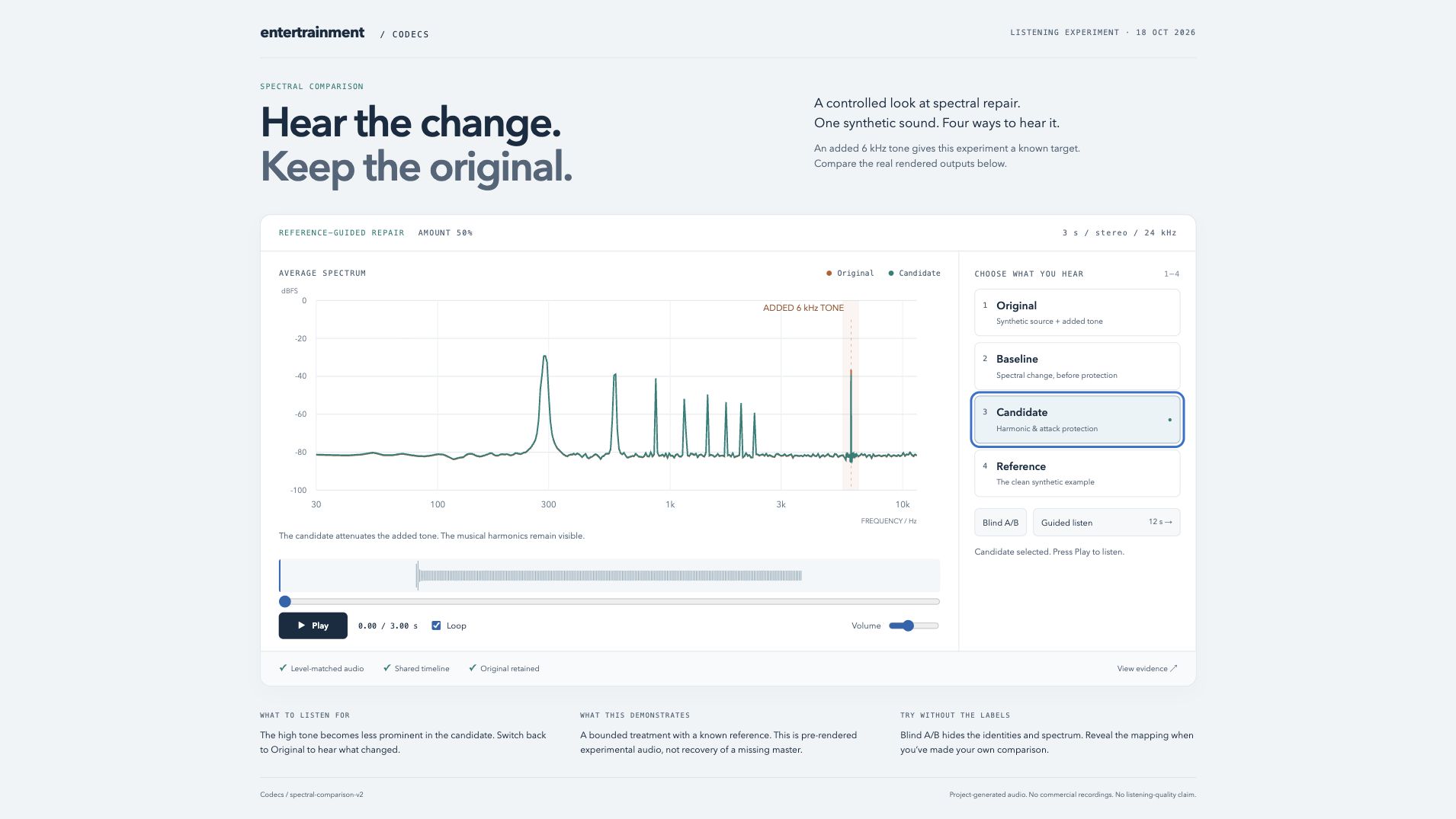
The most defensible public demonstration is a retained synthetic performance with deliberately injected 6 kHz contamination. Four existing audition files let a visitor compare the source, an unprotected change, the protected candidate and the clean reference. This demonstrates the actual processing contract without publishing commercial-song stems. It is a short, known-reference example: success here does not establish general codec restoration, and the files have not received a human listening-quality verdict. The working website player presents these retained files with shared-timeline switching, guided playback and a blind A/B mode. It does not run the native engine in a browser.
The evidence also makes the remaining priorities clear. The character bank refused all three held-out examples in its small evaluation, so broader representative coverage is needed. Automatic room identification and missing-band reconstruction are not implemented. Section-aware clips provide useful planning and exact-range hooks, but their milestone did not execute a structure model or demonstrate installed section playback. Next work should establish real-music listening acceptance, representative reference banks, long-duration and seek behaviour, runtime packaging and current host integration. More feature labels would be less valuable than closing those gaps.
What stands out
- Exact-versus-derived fidelity is enforced in requests, verification and lineage.
- Original/Baseline/Candidate/Reference exposes modelling and treatment differences.
- Retained synthetic media, source hashes and dated receipts support concrete demonstrations.
Current limits
- Research framework and experimental local preview; no verified public release or browser engine.
- Local Python, NumPy, SoundFile and FFmpeg dependencies remain explicit.
- Human preference, broad restoration quality and current AA Music deployment are not established by these receipts.
Features & evidence
Exact archive
component-testedStore stems and restore complete audio or frame ranges.
Recorded evidence
2026-10-10: exact WavPack full/cross-chunk restores; bounded real-stem measurements.
Spectral comparison
component-testedCompare four variants and keep a separate derived take.
Recorded evidence
2026-10-10: 18 Python tests; native release build, packaged-worker tests and recorded preview UI keep/reopen. Current installed app not rechecked.
Character and room hypotheses
component-testedTry a spectral prior or compare supplied impulse matrices.
Recorded evidence
2026-10-10: 40 conditions, 32 comparisons, 8 refusals; all 3 bank holdouts refused. No unknown-room inference.
Host materialization hooks
component-testedRequest exact/proxy/editable views, retain leases and release cache entries.
Recorded evidence
2026-10-10: 21 Swift tests, zero skips, and 36 Python tests passed; release build and example typecheck recorded.
Section clips
component-testedPlan instrument loops against host-approved sections and bar boundaries.
Recorded evidence
2026-10-11: 7 new tests; full run 23 passed, 5 fixture-dependent skips. Source remains untracked; native UI/model execution not demonstrated.
Review updates & corrections
- No new committed release established: HEAD remains 83fa881, dated 2026-10-10; the section/performance additions remain untracked.
- October 18 read-only checks reconfirm all 10 framework and 7 section receipt entries match recorded hashes. This is identity verification, not a new test run.
- All four audition WAV hashes still match the receipt. Both screenshot hashes match yesterday's inspected images; their defects remain.
- Clearance is explicitly marked uncertain for synthetic media because generator provenance is verified but no formal publication licence is recorded. Commercial-song excerpts remain excluded.
- Historical Codecs handoff statements do not establish current AA Music deployment; that belongs to the current host review.
- 18 October 2026: real media handoff integrated into this page; captions distinguish native captures, edited comparisons and working web demonstrations.
Workflow walkthrough
A guide to the native workflow. These steps describe the app; only the recordings and images embedded on this page are available as website demonstrations.
- Proposed website presentation of existing audio: introduce the three-second synthetic fixture and its intentionally added 6 kHz tone. Website playback is not verified by this review.
- Play Original on user request, then Reference at the same listening volume; explain that the clean reference is known for this experiment.
- Compare Baseline with Candidate to expose the effect of harmonic and attack protection.
- Return to Original and explain that the candidate is a separate derivative, not a replacement or recovered master.
- Show the dated method/evidence summary. Offer no native-download or live-processing claim; keep machine-local receipts private.
Planned captures · not yet available
- Native comparison walkthrough — no existing verified video available.
Development biography · earlier archive
Development profile compiled from project source and retained records in October 2026. Dates and test results describe those records; they do not imply a new build, live acceptance test or public release.
Editorial status: Source-backed intake for entertrainment, inspected 17 October 2026. Historical validation is dated below; no builds, benchmarks, app operation or project/site edits were performed during this intake.
Canonical identity: Swift package AcousticianCodecLab; library SemanticAudio; command-line tool codec-lab. “Codecs” is the workspace/project label. Category: audio research and developer infrastructure, with an experimental native comparison interface. Platform: macOS 13+ Swift core and locally configured Python workers. Related projects: AA Music, Acoustician, AssistantApp/NoiseColour Lab, HSEQ/SpectralProcessor and Swift-CBOR-LD. Personal author attribution is not established by the inspected project documents; do not infer a legal author name from the home-directory name or agent ownership.
Project biography
Codecs began with a practical tension inside a music application: separating a recording into several stems makes it more useful for mixing, but also creates much more audio to store, inspect and replay. Compact representations might help, yet convenience must not quietly change the material that subsequent processing treats as authoritative. The project therefore starts with a firm rule: preserve the original recording separately and restore every supplied float32 stem sample exactly whenever an exact representation is requested. Separation itself can change audio, so even a perfectly archived stem is not described as the untouched master.
The work developed into two connected investigations. One asks how to store and retrieve music data with explicit identities, trustworthy range access and manageable temporary caches. The other asks how spectral analysis and synthesis can support deliberate character transfer or cautious reference-guided treatment. Their connection is provenance: each representation records what source it belongs to, what operation produced it and whether it is exact, approximate or intentionally transformed. The intended audience includes developers building music applications, audio researchers examining representations, and producers interested in controlled comparisons.
The archive foundation uses chunked float32 WavPack audio with a CBOR-LD manifest and content-addressed objects. Full restoration and frame-range requests verify both stored objects and decoded sample identities. On two retained twelve-second, six-stem excerpts, the documented exact archives reduced raw PCM storage by approximately 1.50–1.53 times while restoring the original sample bytes. These are bounded measurements, not a universal compression promise. Opus and EnCodec were also explored, but their reconstructed waveforms remain explicitly approximate. They cannot silently satisfy a request for exact material.
The original spectral experiment builds on Acoustician’s harmonic-plus-noise representation. A carrier supplies pitch, voicing and timing controls, while a reference supplies relative harmonic balance and noise colour. The implementation blends spectral power under confidence and protection rules. This makes the transformation inspectable: a user can compare the source, the unmodified synthesis model and the model with transferred character. It also exposes modelling loss. The early renderer resets phase and synthesizes noise, so preserving pitch controls does not mean preserving the recorded waveform or stereo image.
A later experimental comparison engine uses the carrier’s complex spectral phase and shared gains across stereo channels. It supports two distinct purposes. Reference-guided repair compares the same aligned recording and proposes bounded attenuation of supported spectral excess. Character transfer deliberately reshapes spectral balance using another example or a small empirical reference bank. Harmonic ownership and energy-rise protection reduce changes around shared musical components and attacks. Neither mode claims to recreate missing studio-master information; absent high-frequency content is not reconstructed by the implemented repair.
A concrete user journey begins by selecting a source and reference in the native Spectral Comparison window. The listener chooses the purpose and amount, then builds an offline comparison. Original, Baseline, Candidate and Reference are presented with level matching and shared headroom. The baseline reveals the requested change before protection, while the candidate includes the protective logic. Switching retains timeline position. Blind A/B controls support a listening decision, and Keep Derived Take stores a separately identified result that can later be verified and reopened. The source remains available throughout.
The room-modelling strand tests another possible explanation for spectral differences. A supplied impulse-response matrix can model how sound travels between input and output channels. Candidate room explanations are fitted on one portion and evaluated on a held-out portion. This is comparison among known kernels, not automatic discovery of an unknown recording room. NoiseColour Lab descriptors, HSEQ-inspired harmonic protection and isolated Kalman, FIR and Remez probes provide additional research foundations without being presented as a single fully integrated restoration system.
The host-independent framework brings these ideas together as one source with three explicit views: exact archive, approximate proxy and editable derivative. Swift hooks request capabilities, verify a catalogue, prepare complete audio or a selected range, retain a lease and release it when playback consumers finish. Eviction checks that exact backing can actually regenerate the material before discarding a temporary copy. Edits create new derivatives with parent lineage. Parsing, hashing and decoding belong in workers; the audio callback receives prepared material.
A further section-clip layer expresses named sections, instrument activity and host-approved bar boundaries without imposing fixed 4/4 timing. It can plan a chorus vocal loop or verse guitar excerpt, retain exact ranges and keep independent clips associated with their recordings. This is implemented control and materialization infrastructure, not a claim that an installed model already recognizes every chorus or that natural-language performance control is complete. Across the project, the next step is broader musical and listening evidence, packaged host acceptance and clearer integration—not replacing careful measurements with claims of universal restoration or effortless compression.
Main modules and demonstrable workflows
- Exact stem archive: chunked WavPack, deterministic semantic manifest, object integrity checks, complete/range restoration. This is authored orchestration around existing codec and serialization dependencies.
- Spectral character model: typed Swift harmonic/noise controls, reference learning, confidence-gated transfer, compact model storage and separately identified CBOR-LD recipes.
- Spectral comparison worker and native preview: offline repair/character modes, stereo-linked gains, protected candidates, cancellable rendering, four-way comparison, blind controls and verified saved takes.
- Empirical character bank: learns normalized 32-band distributions from multiple distinct recordings; refuses unsupported examples. This is not a trained neural restoration model.
- Room hypothesis comparison: supplied impulse matrices, causal convolution, held-out comparison and explicit tail accounting.
- One-source materialization framework: exact/proxy/editable intents, registered decoder pairs, pinned identities, persistent leases, recoverability-checked eviction and cancellation of worker process groups.
- Section clips: named section proposals, instrument activity, variable bar boundaries, loop slices, independent A/B clip state and exact-default materialization. No automatic structure-model execution was demonstrated in this milestone.
Technical foundations
The core uses Swift 6, a macOS 13 deployment target and the local Swift-CBOR-LD package through CBORLD_PATH or ../../cborld-main. It does not change that package’s shared wire format. Python components use NumPy, SoundFile and FFmpeg, with explicit locally configured runtimes.
Acoustician provides the actual-source harmonic/noise analysis and synthesis foundations exercised by the early probe. NoiseColour Lab supplied examined and, for selected components, executed analysis and room-response code. HSEQ supplies the inspiration for log-frequency harmonic ownership; the Python protection formula is an adaptation, not full HSEQ parity.
Native Kalman, FIRFilters and Remez packages were investigated through isolated consumers. The October 10 provenance report distinguishes the canonical RemezEngine worktree from the deprecated RemezEngineFixed dependency still referenced by an inspected consumer. Do not describe those probes as packages linked into the production spectral worker. Its gain smoothing uses versioned Python Kalman equations.
The framework catalogue is bounded canonical JSON referencing existing CBOR-LD archives. The integrated take receipt is JSON schema 2; the initial Swift spectral recipe uses experimental CBOR-LD dictionary 60002. A unified archive-v2 graph is not complete.
Maturity and dated evidence
| Surface | Evidence retained | Appropriate public status |
|---|---|---|
| Exact archive | October 10 full/range byte-equal restores on two twelve-second six-stem excerpts; measured storage and release timing receipts | Implemented, locally tested research infrastructure; no general full-song latency claim |
| Early spectral synthesis | October 10 eight-channel, two-song, three-second experiments; exact model round trips and same-runtime repeatability | Experimental character transformation; stereo/phase limitations documented |
| Spectral preview | October 10 receipt: 18 Python methods passed, release build and ad-hoc signing passed, packaged-worker/native decode/keep/reopen tests, recorded native picker/render/switch/keep/reopen actions | Locally built experimental native workflow; no human listening verdict or screenshot acceptance |
| Integrated evaluation | 40 conditions: 32 completed comparisons and 8 refusals; three character-bank held-out examples all refused | Bounded evaluation, with coverage failure retained; “ready” does not mean improved sound |
| Materialization framework | October 10: 21 Swift tests, zero skips; 36 Python tests across four suites; zero failures; release build and host example typecheck | Implemented and independently reviewed framework; that milestone did not establish installed host acceptance |
| Section clips | October 11: seven focused new Swift tests; full run 23 passed, 5 existing fixture-dependent tests skipped; release build recorded | Framework implementation, not deployed structure recognition or clip UI |
Roadmap and limitations
Priorities are broader held-out musical examples and actual listening evaluation; improved character-bank coverage; explicit long-duration/stereo/seek/join acceptance; packaged runtime and host integration; source-preserving section playback and model execution; and an explicitly versioned richer representation graph.
Important boundaries remain: no general missing-band reconstruction, unknown-room recovery, calibrated perceptual-quality score, iOS/web deployment or cross-platform exact resynthesis guarantee. The integrated input limit of 30 minutes is not a 30-minute soak result: numerical join checks cover 70 seconds and real examples are three-second excerpts. The early model-plus-exact-correction packages were 1.57–2.13 times larger than direct WavPack, so their smaller synthesis controls do not establish a compression win. Warm framework verification deliberately decodes source authority again, so correctness evidence is not a warm-playback speed claim.
FAQs
Does it restore the original recording exactly? The WavPack archive path restores the supplied stem PCM exactly. Spectral repair and character transfer create separate derivatives. The original recording must also be retained because source separation can already change its waveform.
Is the spectral feature a neural model? The implemented transfer and repair are interpretable DSP. The character bank learns empirical spectral distributions. EnCodec was investigated separately as an approximate neural codec; it is not the restoration engine.
Can it make a low-quality file equivalent to a studio master? No. The implemented repair requires a compatible aligned reference and proposes bounded changes. Missing information is not proven recovered, and lowpass deficits are not reconstructed.
Can another app use it? The Swift library and asynchronous materialization hooks are designed for host integration. A host supplies trusted bindings, prepares audio off its real-time callback and manages leases. Packaging and installed acceptance remain separate milestones.
Can the website demonstrate it now? It can present the retained synthetic comparison assets with clear experimental labels. A polished screenshot or video is not presently verified. The native preview is local, not a browser application.