Source reviewed 18 October 2026. Research software; no fresh build, device acceptance or clinical outcome is established by this review.
Gait & Recovery Rehab brings movement sensing and acoustic support into a single research workflow. Its iOS Rehab Gait Companion presents live gait and balance summaries, affected-side and cadence settings, rhythmic auditory and haptic pacing, session capture and export. Pacing can use alternating, steady or accented patterns and a gradual transition from observed cadence toward a configured target. A second Audio Support surface exposes NoiseColour support and the fusion/safety inspector.
Behind the interface, the gait bridge represents cadence, speed, step and stride timing, asymmetry, variability, movement state, balance and turn confidence. A therapeutic-fusion controller combines this movement context with room/acoustic evidence and task configuration. The source represents overground walking, treadmill walking, hallway turns, sit-to-stand and dual-task walking. Confidence floors, stale-data fallback, complexity and salience limits, and hold behaviour constrain what the renderer may apply.
Recovery Triplet is an experimental sequence linking an autonomic lead, a gait deviation and a timed resolution cue. Its state model exposes hold, decay, resolution and suppression, with explicit reasons such as low confidence, stale physiology, high fall risk, cooldown and unavailable audio route. Watch physiology packets and a contact-pulse proxy carry source, timing and signal-quality metadata. These mechanisms support investigation of timing and response; they do not establish a clinical recovery effect.
The source also provides structured decision and renderer events, operator overrides, protocol phases, recorded sessions, scenario replay and short response windows. Session export carries gait samples, fusion decisions, triplet traces and cross-device timing metrics. Health trends remain slower contextual information, while research intake records are explicitly separated from live gait scoring and cue selection. Some advanced views are defined in source but are not yet connected to the app’s navigation.
Inside the project
Gait/balance capture and semantics; rhythmic auditory/haptic pacing; NoiseColour support; mobility/acoustic fusion; safety and confidence; Recovery Triplet; physiology quality and freshness; session recording/export; protocol and replay models; optional research intake.
Native workflow
The interface brings permissions, cadence, affected-side and task settings into a session workflow, alongside signal inspection, fallback status, selected audio/haptic support, stop controls and export. Sensor availability and runtime behaviour require device verification; this source review did not run a participant session.
Demonstration status
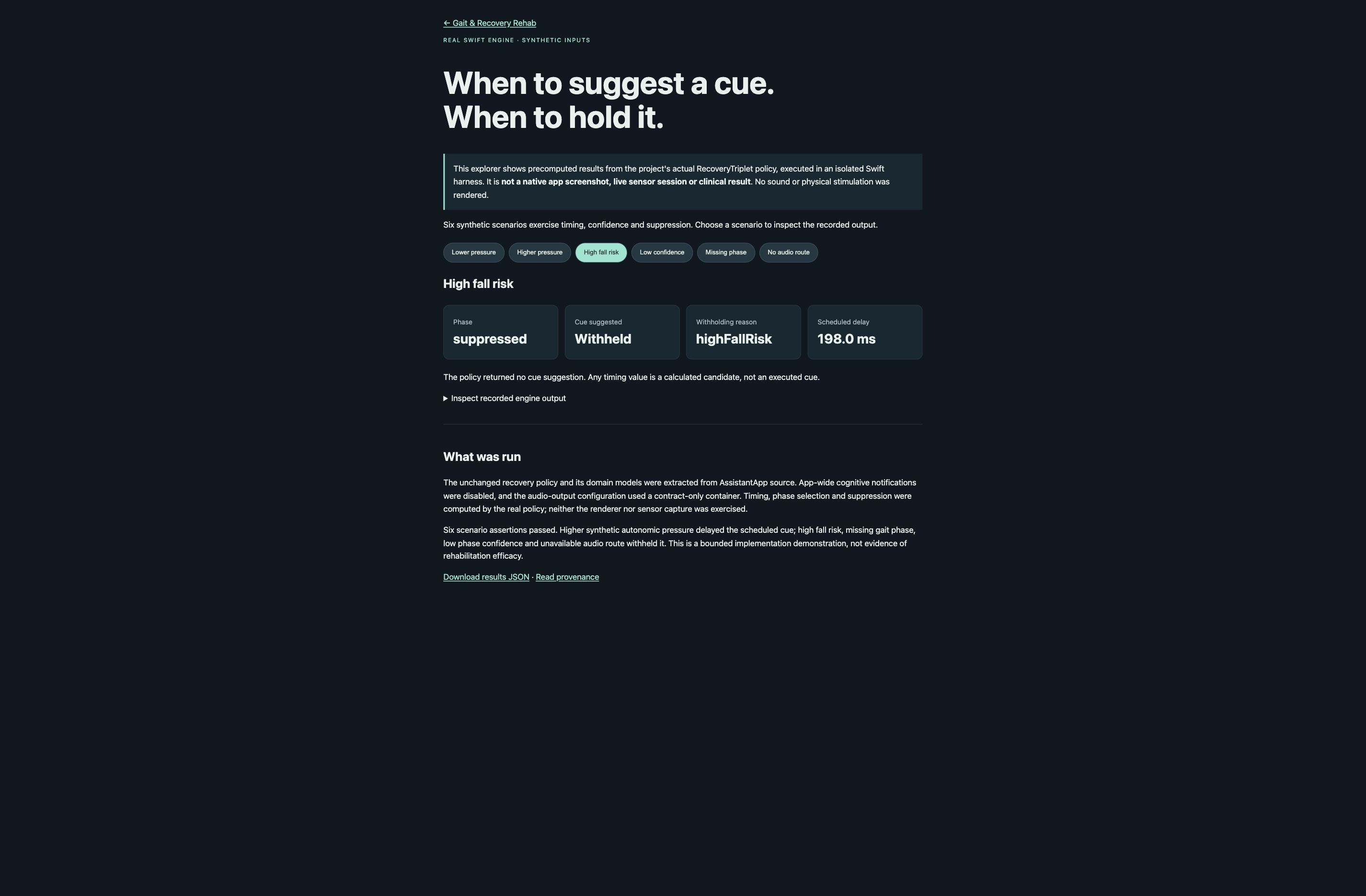
The interactive engine demonstration above shows six synthetic scenarios executed by the actual Swift RecoveryTriplet policy. Lower and higher autonomic pressure produce scheduled cue delays of 172.4 ms and 272.5 ms. High fall risk, low confidence, missing gait phase and an unavailable audio route withhold the cue. The page displays precomputed results; it does not run live sensors, render audio or deliver stimulation. Native companion-app screenshots and video remain unavailable.