Source reviewed 18 October 2026. Research software; no fresh build, device acceptance or clinical outcome is established by this review.
NeuroControlKit explores how an assistant can turn changing context into bounded, explainable suggestions. It accepts a cognitive-state representation, smooths its dynamics, estimates load, maps patterns and classifies the resulting state. Reinforcement-learning, active-inference, phase-locking and stability controllers contribute proposals. A cortical workspace and action gate arbitrate those proposals before a safety governor constrains the final stimulus parameters. The model exposes its decisions, routing and reasoning packets for inspection.
The broader source includes semantic workspace routing, language situation/action planning and an optional Thousand-Brains-inspired cognitive cycle: recognition, structured uncertainty, episodic retrieval, memory-grounded simulation and graded proposal authority. These are computational models; state labels and confidence values are not measurements of a person's brain or verified mental condition.
In Sonics/Mau Mau's Focus surface, a dedicated NeuroControlKit simulation can receive the available arousal, cognitive-load and stability proxies from the Multimodal Regulation pane. Unmeasured axes stay at neutral defaults, missing or stale signals remain visible, and the default output is advice. An experimental, explicitly enabled steering path is bounded, cannot start playback, and ends when its panel closes. The app-wide model is a separate optional read-only connection, not the default source for this panel.
The rehabilitation adapter represents movement quality and remembered cue outcomes as evidence. It proposes cue adjustments at preview authority and treats a fall/strain risk flag as a reason to deny escalation. This connects the cognitive research work to rehabilitation research without treating a simulation as a diagnosis or an autonomous therapist.
Inside the project
State and load modelling; ESN/SOM/Neural-ODE components; RL/active-inference/PLL/stability proposals; cortical arbitration and safety governor; semantic workspace routing and language planning; optional recognition/uncertainty/episodic cycle; Sonics advisory bridge; preview-only rehabilitation adapter.
Demonstration status
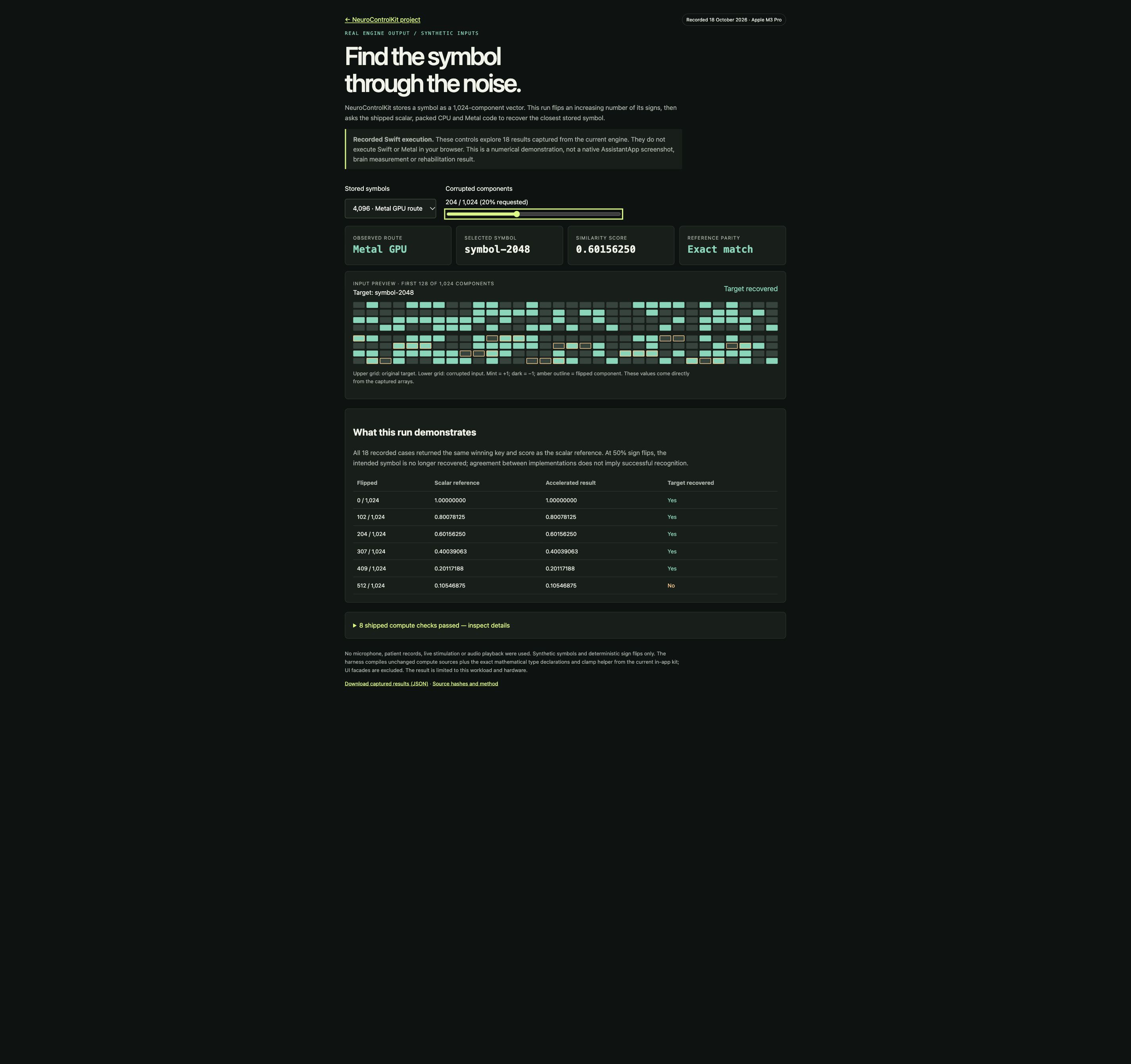
The interactive compute demonstration above replays actual execution of the current scalar, packed CPU and Metal implementation on synthetic symbols. Eight shipped compute checks passed, and all 18 comparison cases returned exactly the same winning symbol and score across reference and accelerated implementations. Six cases exercised Metal with 4,096 stored symbols. The intended symbol was recovered through 40% requested sign corruption and was not recovered at 50%; the viewer shows that failure. These results demonstrate this numerical workload on one Apple M3 Pro, not the full cognitive pipeline or a clinical effect. Native app screenshots and video remain unavailable.