Public release & what visitors can try
The public distribution README identifies v1.23.0 with 188 verified families and 20 MCP tools. It distributes commercial binaries and release evidence; implementation source is not distributed in this repository. The quickstart covers the parity CLI, MCP server and Live verifier, including explicit floating-point tolerances and exact integer comparisons.
Use the embedded product site to explore the verification workflow, evidence and installation options. Native compute operations require an active entitlement. The README states that hosted browser execution remains disabled until a pinned runner passes its public canary, so embedding this site does not make native or NVIDIA execution available here. Release figures are published project evidence, not a new test run by this portfolio.
Inside the project
Prepared with the project’s development agent from source and retained evidence. This is a project-owner assessment, not an independent customer review. Dated checks were not rerun for this website.
SemanticCompute is a numerical-verification substrate: write a computation once as typed IR, lower it to Metal, portable C, WebGPU and CUDA, and prove each agrees with a deterministic CPU reference under an explicitly stated tolerance — or get the exact coordinate and cause of any divergence (FMA drift, denormal flush, NaN). It is the diagnostic layer beyond allclose, aimed at GPU/kernel and DSP engineers, ML-kernel authors, regulated teams, and AI agents (via a read-only MCP server). Its defining honesty: parity proves backends AGREE, not that either is RIGHT, and it is blind to conditioning — so accuracy is only claimed where a family ships a Double ground truth. It ships at v1.29.0 as signed/notarised binaries, a CLI and an MCP server, with a 270+ family catalogue. This is a project-owner review, not an independent endorsement; no ratings or user feedback are claimed.
What stands out
- Stated-tolerance parity as a first-class contract, with coordinate-located, cause-classified divergence (not a bare pass/fail).
- One typed IR lowered to four backends; three (Metal, portable C, WGSL) execute and parity-verify IN CORE; CUDA is emitted in core and executed+parity-verified by an optional external NVIDIA runner.
- 270+ families, each held to a five-checkpoint bar (CPU reference + semantic contract + legality + lowering + doctor parity) before catalogue registration.
- Honest performance evidence: release builds with a DCE barrier, headlined against a FAIR multithreaded CPU (Goertzel bank ≈28x fair / ≈199x scalar).
- IEEE-safe math discipline (Metal safe mode + precise:: + fp-contract off, C -ffp-contract=off) so CPU/GPU differences are real, not build artefacts.
- Usable by AI agents via 10 read-only, no-network MCP tools.
Current limits
- Parity proves agreement, not correctness, and is blind to conditioning — a bit-exact result can still be numerically wrong (e.g. BiquadResponse ~0.134 dB); needs an independent oracle per family.
- CUDA is emit-in-core, execute-out-of-core: no CUDA runtime in the default build; on-device parity needs the optional NVIDIA runner.
- Performance is workload/hardware-specific; small/real-time/bandwidth-bound kernels can be a wash (pointwise add ≈1.2x) or a loss (tiny Goertzel 0.02x).
- Accuracy figures exist only where a family ships a Double ground truth.
- Commercial licence, no free production tier; signed binaries 1.23.0+ enforce an online entitlement.
Features & evidence
Parity doctor (SLCompatibilityDoctor)
releasedUser runs a family or their own reference/candidate arrays under a stated tolerance; gets pass or a located, cause-classified divergence.
Recorded evidence
v1.29.0 signed dist; file-verified 2026-10-18 SLVersion.swift:21 + SBOM = 1.29.0; README.
Four-backend emission (Metal/C/WGSL/CUDA)
releasedOne IR lowered to four backend sources; user can inspect each.
Recorded evidence
SLVersion.swift backends array; BACKENDS.md.
In-core executed parity (Metal, portable C, WGSL)
releasedThree backends execute and are proven to agree with the CPU reference.
Recorded evidence
BACKENDS.md (WGSL on a real WebGPU device, naga-validated, affine + loop-IR matmul).
CUDA on-device parity (external runner)
component-testedEmitted CUDA executed + parity-verified on real NVIDIA hardware.
Recorded evidence
Integrations/SemanticComputeCUDA/cuda-parity-evidence.txt; 16 comparisons x2 on 2x RTX 5080 (driver 570.211.01) + earlier 2x RTX 5060 Ti; later RTX 5880 Ada run in release lineage (unverified this session).
270+ kernel-family catalogue
releasedBrowse/select proven families; define new ones to the five-checkpoint bar.
Recorded evidence
KernelFamilyCatalog.swift ~283 .init(name:) in-tree (ahead of ~274 tag); publish '270+', pin to tag.
MCP server (10 read-only tools)
releasedAgent calls sc_check_parity/sc_ulp_distance/sc_diagnose_divergence etc. with no network.
Recorded evidence
Package.swift product semanticcompute-mcp; MCP.md.
Parity CLI + divergence zoo (semanticcompute-parity, --zoo)
releasedUser pipes JSON/stdin arrays; CI exit codes; --zoo runs the known-bad failure lab.
Recorded evidence
Package.swift product.
Measured accuracy (SLAccuracy, Double ground truth)
releasedWhere a family ships a Double reference, reports accuracy not just agreement.
Recorded evidence
README; families e.g. CompensatedSum/LogSumExp/MatMul.
Prescribe-then-re-verify remedy
component-testedDoctor suggests a verified whole-op substitution re-proved against the user's frozen reference; never edits source, never self-certifies.
Recorded evidence
Release-lineage (landed); not re-verified at file level this session.
Metrics monitor + licence enforcement
releasedOpt-in local-only usage metrics (menu-bar app, off by default); signed binaries check an online entitlement per operation.
Recorded evidence
Package.swift product; METRICS.md; docs/pricing.html (1.23.0+ entitlement, 1.24.0+ MCP resources/prompts).
Review updates & corrections
- No material code changes since the 17 Oct biography; same v1.29.0 state (re-verified 2026-10-18: SLVersion.swift:21 + SBOM = 1.29.0).
- Resolved: the 1.9.3-vs-1.29.0 version concern raised mid-session on 17 Oct was a stale read; the worktree is confirmed at 1.29.0.
- In-tree catalogue now ~283 .init(name:) entries (worktree [Unreleased] adds Fuzz-Factory + MNA netlist, ahead of the ~274 tag) — still publish '270+', pin to the tag.
- The older recursive stress-test scratch (SC_STRESS lab) remains internal, not a product/review surface — not relevant; omitted.
Workflow walkthrough
Explore the live project website above. The steps below describe the development workflow; native operations may require a separate installation.
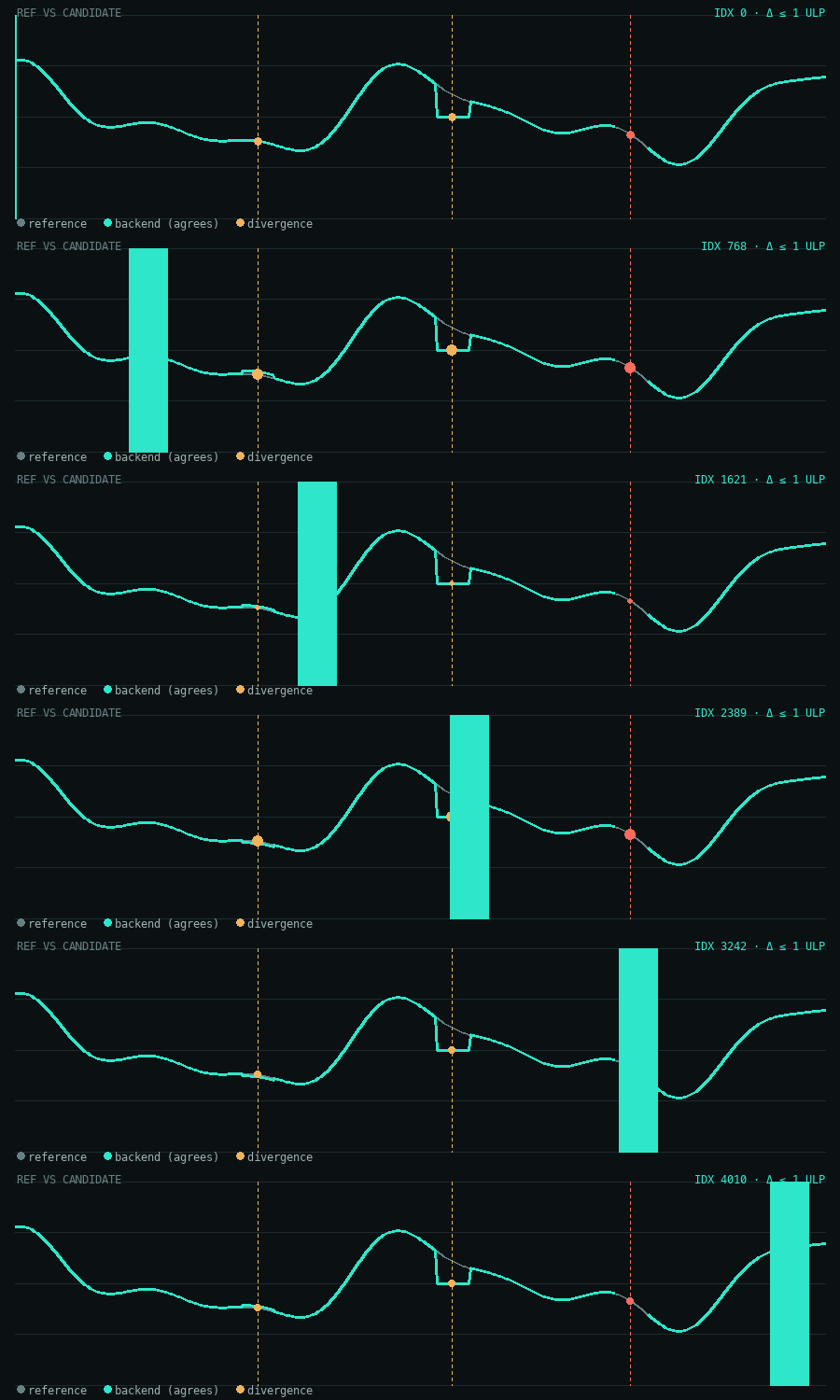
- Open the live page to watch the parity scope animate a reference vs a candidate signal with divergences flagged (interactive on the website).
- In your project, pick a family (sc_list_families) or pipe your own reference+candidate arrays to the semanticcompute-parity CLI / sc_check_parity with a stated tolerance.
- Read the verdict: within tolerance, or a located (x,y,z) divergence classified by cause.
- Run sc_diagnose_divergence for the per-element cause map and a suggested remedy (prescribed, not applied).
- Fix it yourself and re-run until green; wrap your production GPU path in that same parity contract.
- Optionally run --zoo to confirm the doctor still catches known-bad cases.
Planned captures · not yet available
- Proposed screencast of the parity CLI/MCP flow — does not exist; would be a new capture.
Development biography · earlier archive
Development profile compiled from project source and retained records in October 2026. Dates and test results describe those records; they do not imply a new build, live acceptance test or public release.
A numerical contract across backends
The problem. Floating-point code that "looks right" and passes a coarse allclose can still be wrong in ways that matter: a GPU port that fused a multiply-add where the CPU didn't, a backend that flushed denormals to zero, a reduction reassociated into a different rounding order, a NaN swallowed instead of propagated. These differences are invisible to a single tolerance check and expensive to find by hand — and they multiply across every backend a team targets (Apple GPUs, portable C, the browser via WebGPU, NVIDIA via CUDA). The industry-standard answer, numpy.allclose/torch.allclose, returns a single pass/fail and tells you nothing about the cause or the location.
What SemanticCompute is. It is a deliberately restricted, compute-oriented semantic middle layer — explicitly NOT an "arbitrary Swift to GPU" transpiler . A computation is written once as a typed intermediate representation (SLKernel). A single optimising front door (SLKernelCompiler) lowers that one IR to four backend languages, and a deterministic CPU reference executor (SLReferenceExecutor) is treated as ground truth. The product people actually reach for is the compatibility doctor (SLCompatibilityDoctor): it runs a kernel family against each backend and proves agreement with the CPU reference under a tolerance that is always stated, never hidden — or it reports, per coordinate, where the two diverge and classifies the cause.
Origin / motivation (as documented in-tree). The project's own source records the motivation behind its discipline rather than a marketing origin story. SLVersion.swift explains why even the version constant exists: "two sessions in one day lost time to the same question and could not answer it from the tool: which build am I actually talking to?" — so the build carries a machine-readable capability manifest and a build-commit stamp (committed value deliberately "unknown", real only in a release artefact). The README positions the whole tool as "the diagnostic layer beyond allclose", and AGENTS.md frames it as "a semantic compute substrate, not a general Swift-to-GPU transpiler" whose first duty is correctness. The honesty is structural: a governance test enforces that the CHANGELOG's top version equals the code's version , so release notes can never drift from what shipped.
Who it serves and how it works
Intended audience. GPU and kernel developers porting numerical code across backends; DSP and scientific-computing engineers who need auditable batch results; ML-kernel authors (Triton/CUDA/FlashAttention-style work) who need more than allclose; and regulated or safety-critical teams who must show why a result is trusted. A distinct, deliberate audience is AI agents: the MCP server lets an autonomous tool prove its own numerics. Commercial tiers reflect this split — a solo production tier and an enterprise/regulated tier.
Distinctive ideas. (1) Parity as a first-class, stated contract rather than an afterthought assertion. (2) The CPU reference as a deterministic oracle shared by every backend. (3) Shape-aware, cause-classified divergence — a mismatch is a located (x,y,z) coordinate with a named cause, not a bare "failed". (4) A hard honesty boundary: parity proves agreement, not correctness (two backends can agree on the same wrong answer), and it is blind to conditioning (a bit-exact result can still be numerically wrong). (5) "Prescribe, then re-verify" — the doctor may suggest a verified whole-op substitution from its own proven library, re-proved against the user's frozen reference, but never rewrites the user's kernel source and never self-certifies.
What it does, concretely. For each kernel family it emits the four backend sources, executes the ones the host supports, and compares each to the CPU reference under a chosen tolerance tier (.exact, .defaultFloat ≈ 1e-6/1e-5, .ulp(n), or custom). Where a family ships a higher-precision Double ground truth, the same machinery reports measured accuracy (SLAccuracy), not just cross-backend agreement. A curated "divergence zoo" of known-bad cases proves the doctor still catches what it should.
A concrete user journey. A developer has a hand-written Metal kernel they suspect disagrees with their NumPy reference. They pipe both arrays into the semanticcompute-parity CLI (or call sc_check_parity from an MCP client) with a stated tolerance. The doctor reports a divergence at a specific coordinate, classified as FMA contraction. They run sc_diagnose_divergence for the per-element cause map and a suggested remedy, apply the fix themselves, and re-run until the contract is green — then wrap their production GPU path in that same parity contract so the fast path is only ever trusted where it has been proven to match the reference.
Main modules / features (authored vs dependencies)
What a visitor can actually see / try:
- See: the animated parity scope (docs/scope.gif) and the live interactive page; a shareable HTML verification report (docs/verification-report.html).
- Try: the runnable examples (KernelBench-style generate-verify-fix loop; Triton/vLLM/FlashAttention output verification) and the
--zoofailure lab.
Dependencies: none external in the Swift package — the four emitters are pure Swift and the manifest declares no third-party SwiftPM dependencies . The optional CUDA runner relies on an external NVIDIA toolchain/driver by nature.
Technical foundations & integrations (local packages named)
- One IR, four emit backends:
SLKernel→ Metal (MSL,SLMetalEmitter), portable C (fixedsl_runABI,SLCEmitter), WebGPU (WGSL,SLWGSLEmitter), CUDA C++ (SLCUDAEmitter). Emission is always available; runtime executability is queried viaSLBackendAvailability. - IEEE-safe math discipline: Metal
MTLMathMode.safe+precise::builtins + an fp-contract pragma; C compiled-ffp-contract=off— so a CPU/GPU difference is the backend's real behaviour, not a build artefact. - Local integration packages (in-tree,
Integrations/): Integrations/SemanticComputeCUDA— the OPTIONAL, separate NVIDIA runner that executes and parity-verifies the emitted CUDA on real hardware (not part of the default build); carries committed on-device evidence.Integrations/VerifyNumericsPlugin— averify-numericsSwiftPM command plugin that surfaces divergences as Xcode Issue-Navigator diagnostics.Integrations/python— Python-side integration/examples.- Distribution design: source development with a separate
semanticcompute-distchannel for binaries, documentation and a website; signed + notarised universal macOS binaries, container images, MCP bundle, checksums, SBOM, provenance.
Current maturity by feature (evidence, versions, dates)
The project agent inspected source and retained release evidence on 17 October 2026. No new native build, benchmark or full test run was performed for this profile.
- Inspected version: v1.29.0 in the reporting worktree. Source-verified: SLVersion.swift:21 (major 1, minor 29, patch 0) AND Tools/sca/semanticcompute.cdx.json both read 1.29.0 — they agree. Tagged 2026-10-13 per release lineage (not re-verified against the tag this session).
- Kernel-family library: 270+ families, each held to the full five-checkpoint bar (CPU reference + SLSemanticContract + legality + backend lowering + doctor parity, then catalogue registration). In-tree count: ~283
.init(name:)entries in KernelFamilyCatalog.swift (this worktree's [Unreleased] adds Fuzz-Factory + MNA netlist families, so it is slightly AHEAD of the tag; release record ≈274). The supported release-level description is 270+ families; unreleased worktree additions are separate. - Three backends — executed + parity-verified IN CORE: Metal (Apple GPUs), portable C (clang → dlopen), WGSL (on a real WebGPU device via wgpu→Metal, naga-validated; execution-parity-tested on affine + loop-IR matmul under the doctor's tolerance). Evidence: BACKENDS.md.
- CUDA — EMISSION in core, executed by the OPTIONAL external runner: SLBackendKind.cuda's own doc comment states emission-only in the default build; on-device execution/parity is Integrations/SemanticComputeCUDA. Committed evidence file Integrations/SemanticComputeCUDA/cuda-parity-evidence.txt; BACKENDS.md records 16 on-device comparisons passing twice on 2× RTX 5080 (driver 570.211.01) and an earlier 13-comparison run on 2× RTX 5060 Ti. The documented boundary is three executed and parity-verified backends in core, plus the optional externally verified CUDA runner.
- Performance: measured per DSP_PROVING_GROUND.md on Apple M3 Pro,
-c release, with a dead-code-elimination barrier, GPU vs FAIR multithreaded CPU and vs scalar: Goertzel bank (4096×16384) ≈28× fair / ≈199× scalar; transcendental synth ≈2.6× fair / ≈7× scalar; pointwise add (4.2M, bandwidth-bound) ≈1.2× (a wash); Goertzel tiny (8×256, real-time) 0.02× (GPU loses). The fair comparison is the relevant figure; earlier 205×/280× were debug-build artefacts, corrected. Batch, not real-time. - Tests / CI: source-verified fact — GovernanceGateTests + a CI doc-sync step enforce CHANGELOG-top == SLVersion.string . Exact passing test COUNTS are NOT reported by the project agent on 17 October 2026 (read-only); release records cite a large, growing suite (hundreds to ~1,000+ across milestones). Exact test-count claims need the matching release CI result.
- Cross-platform: library + CLI + MCP build and pass on macOS and Linux (Swift 6.2) per release records; not re-run this session.
- Licensing/distribution maturity: signed/notarised dist through the 1.2x line; signed binaries 1.23.0+ require an online licence entitlement before CLI/MCP/Live ops (1.24.0+ extends to MCP resources/prompts) — per docs/pricing.html. Billing→licence-issuance wiring and the source-private flip are NOT yet complete (roadmap).
Roadmap, limitations, FAQs
Roadmap :
- Normalised execution-contract derivation from a generic SLKernel (beyond specimen-family CPU paths).
- Descriptor-driven lowering.
- First-class normalised boundary semantics (stencils are currently 3×3 clamp-to-edge; boundary facts not yet first-class).
- Richer 2D parity reporting beyond flat buffers; broader generic semantic execution.
- Commercialisation: billing→licence issuance wiring; EULA lawyer review; source-private flip (planned).
Limitations:
- Not a general transpiler — a restricted compute IR by design.
- Parity proves agreement, not truth, and is blind to conditioning; correctness needs an independent oracle per family.
- CUDA is emit-in-core, execute-out-of-core (no CUDA runtime in the default build).
- Performance is workload/hardware-specific; small/real-time/bandwidth-bound kernels may be a wash or a loss.
- Accuracy figures exist only where a family ships a Double ground truth.
- Commercial licence; no free production tier; signed binaries 1.23.0+ enforce an online entitlement.
FAQs:
- Isn't this numpy/torch allclose? No — the diagnostic layer beyond allclose: locates the divergence by coordinate, classifies the cause, states the tolerance, across four lowered backends vs one typed reference.
- Do all four backends run on my machine? Three execute in core (Metal, portable C, WGSL). CUDA is emitted/validated in core; running it needs the optional NVIDIA runner and an NVIDIA GPU.
- If CPU and GPU agree, is my kernel correct? Not necessarily — they can agree on the same wrong answer, and parity can't see conditioning. Pair it with an independent oracle; where a Double ground truth exists, accuracy is measured directly.
- Will it rewrite my kernel to fix it? No — it can prescribe a verified whole-op substitution re-proved against the caller’s frozen reference, but never edits your source and never self-certifies.
- Does it phone home? The numerical verification path is local. Optional JSONL metrics are also local and disabled by default. Signed commercial binaries perform an online licence check; source builds do not.