Inside the project
Prepared with the project’s development agent from source and retained evidence. This is a project-owner assessment, not an independent customer review. Dated checks were not rerun for this website.
The Vocal Expression module is the subject-grounded core of model1: it takes the app's live reading of a person's own voice, turns it into a word-free 'support stance', and either voices that stance back, hands a meaning to another speaker in their own vocabulary, or routes it to assistance actions. It is implemented and component-tested end to end in source; it has not been run live in this inspection, and its signals are assistive proxies, never clinical readings.
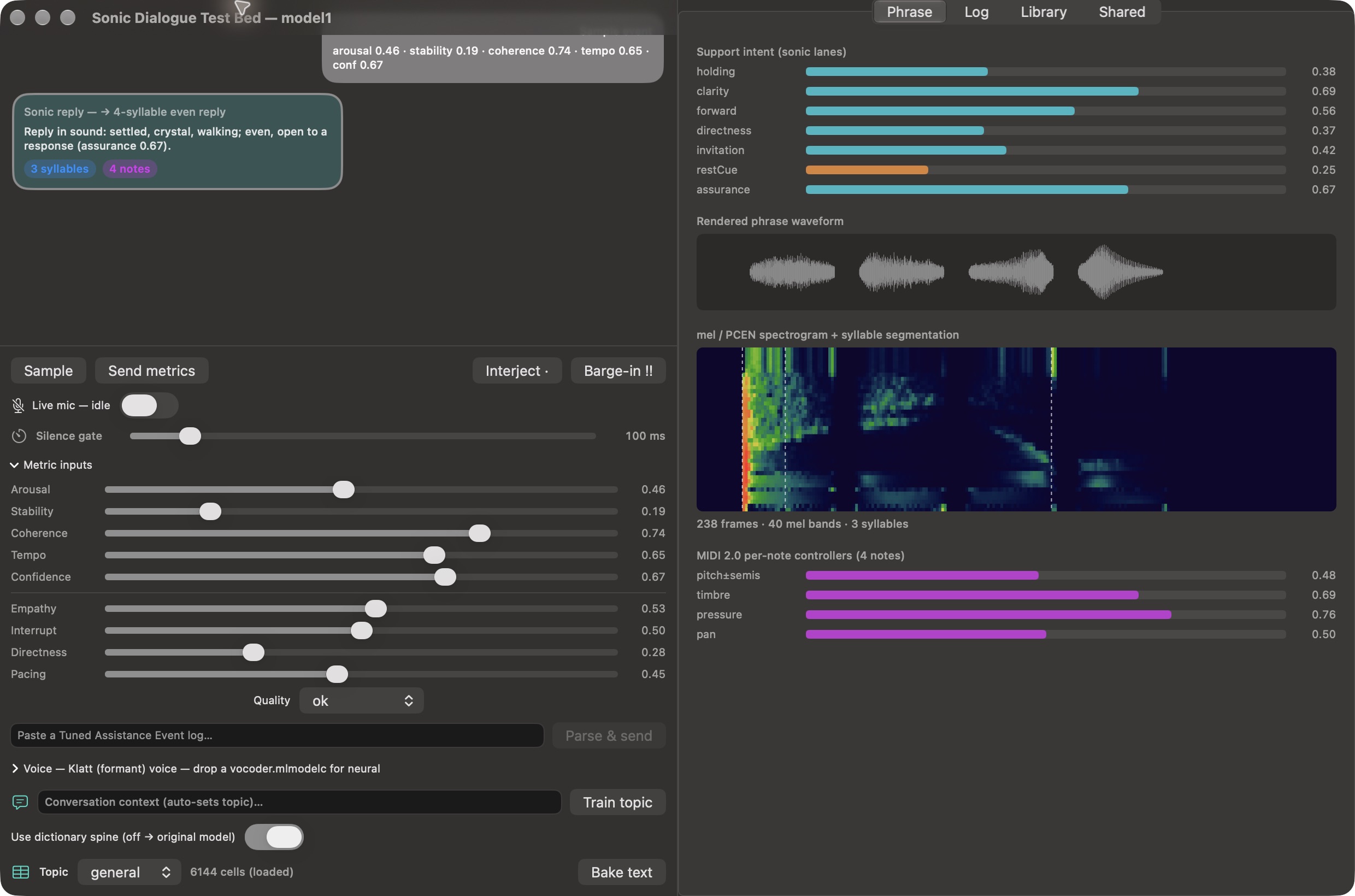
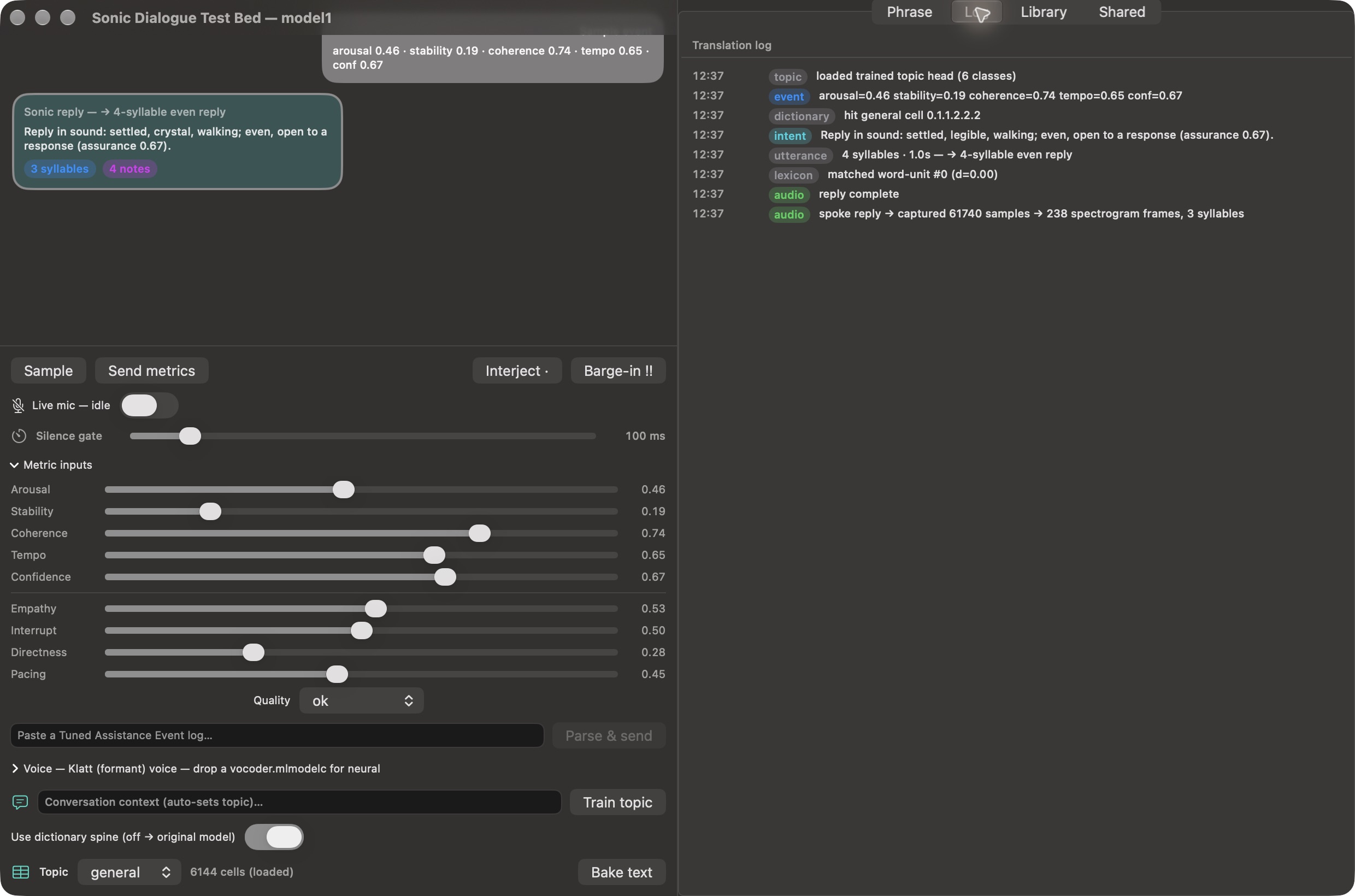
On 18 October 2026 the real native Sonic Dialogue Test Bed was captured using its built-in synthetic sample with the live microphone off. The screenshots show the generated phrase, support-intent lanes, waveform, spectrogram, MIDI 2.0 controls and translation log. A 12.3-second silent interface recording accompanies them. This demonstrates the native sample workflow visually; no audio listening acceptance, live voice interpretation or clinical result is established. A separate browser fixture explorer executes nine real WebAssembly modules with deterministic synthetic responses. It demonstrates the response contracts and display routing, not the full native analysis engine.
What stands out
Current limits
Features & evidence
Subject-grounded event mirror
component-testedReads the live model's per-utterance signals/quality/tuning for the speaker; replayable from a logged event or synthetic sample.
Recorded evidence
VXRTunedAssistanceEvent (.sample + parsingLog init); mirrors VocalExpression.swift DerivedRegulationSignals/AssistanceTuning; swiftc/XCTest.
Meaning map (7 support lanes)
component-testedDeterministically turns the voice state into a word-free support stance; quality gates assurance.
Recorded evidence
VXRSupportIntent.from(event:); Tests/AssistantAppTests/VXRVocalResponseTests.swift.
Codebook representation (8-dim → word-units)
component-testedRecurring expressions quantise into reusable, named vocal units.
Recorded evidence
VXRExpressionFeatures (dim=8) + VXRExpressionCodebook k-means swiftc self-test.
Recipient routing (shared lexicon translate)
component-testedVoice a meaning in another speaker's vocabulary.
Recorded evidence
VXRLexiconTranslator.translate; test-bed translateLast; standalone 2-speaker verification.
Action routing to assistance (node → tuning → execution)
sourceHold the mic on a node; its expression sets assistance tuning + vox: tags the execution layer consumes.
Recorded evidence
NodeVocalExpressionController:118 → AssistancePolicyMapper.map → node.vocalExpression; VocalShapedSupportBridge.swift:42. Runtime capture NOT verified.
Review updates & corrections
- No change to 17 Oct family maturity; this object adds the module-internal representation + routing detail your follow-up requested.
- Re-verified in current source this session: VXRLexiconTranslator.translate (recipient routing); NodeVocalExpressionController → AssistancePolicyMapper + node.vocalExpression + vox: tags, and VocalShapedSupportBridge (action routing into the task execution layer).
- Source hygiene note (not website copy): a commented-out duplicate 'VocalExpression 2.swift' exists alongside VocalExpression.swift — inert, but a known '… 2.swift' build hazard if un-commented.
- On 18 October 2026 the real native Sonic Dialogue Test Bed was captured using its built-in synthetic sample with the live microphone off. The screenshots show the generated phrase, support-intent lanes, waveform, spectrogram, MIDI 2.0 controls and translation log. A 12.3-second silent interface recording accompanies them. This demonstrates the native sample workflow visually; no audio listening acceptance, live voice interpretation or clinical result is established. A separate browser fixture explorer executes nine real WebAssembly modules with deterministic synthetic responses. It demonstrates the response contracts and display routing, not the full native analysis engine.
Planned captures · not yet available
- Shared tab: seed a second speaker, Align, Translate-last → the same meaning voiced in the other speaker's vernacular.
- Node-map: hold the mic on a node → capture → support popover with vox: tags and applied assistance tuning.